Social listening for Instagram is the practice of tracking what people say about your brand on Instagram. Unfortunately, it is not as simple as searching for videos that talk about a brand. Brands often appear in videos without ever being mentioned in the audio or the caption. In Sociable AI's data, around 9 in 10 Reels in which a brand is referenced never name it in the caption. Luckily, there are tools that can spot a brand in the video itself, and we'll get to those further down.
What is social listening on Instagram?
Social listening on Instagram means tracking every post that references your brand, whether or not the poster tagged you. Social media monitoring is the narrower version, covering only the posts aimed at you, such as tags, mentions, and comments on your own posts.
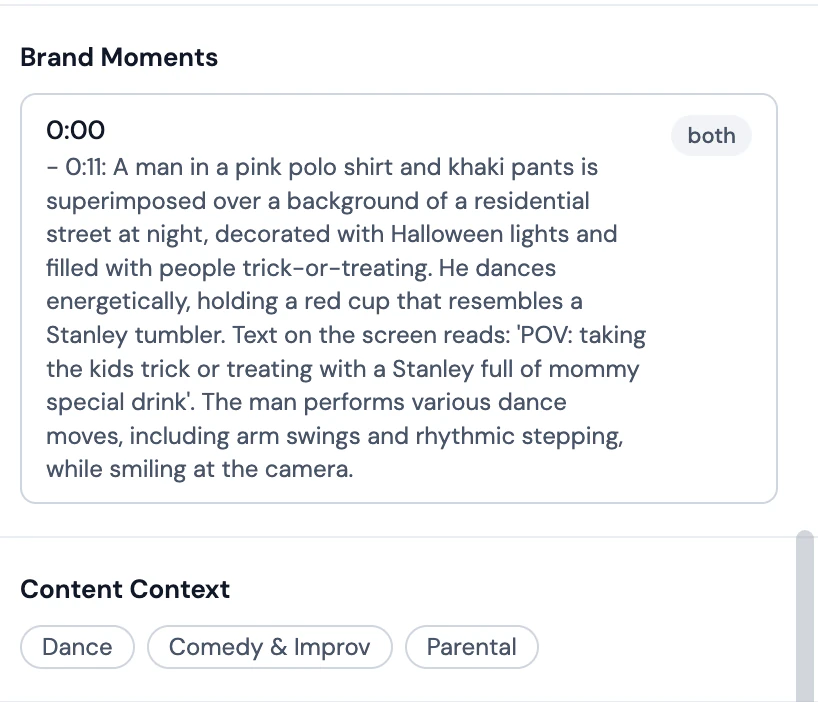
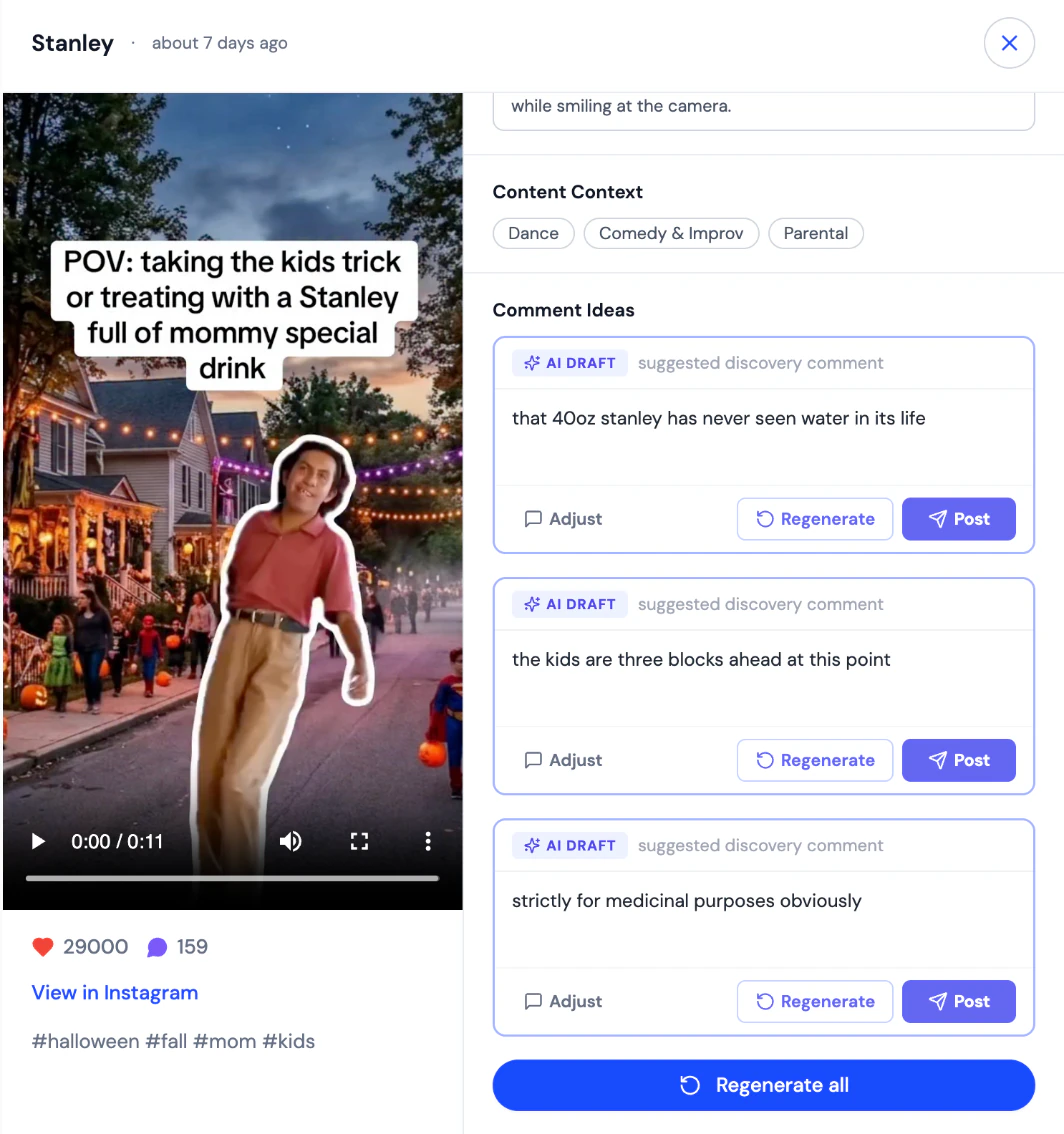
On Instagram, a mention is very often visual or spoken rather than written. Take this Halloween Reel where a dad walks the kids around the neighbourhood with a Stanley tumbler in his hand. The brand is readable on the side of the cup, the caption is about the costumes and the candy, and there is no tag anywhere.
Why brands use social listening on Instagram
Brands use social listening on Instagram for five reasons.
Customer feedback is the first. People say what they like and dislike about a product in their own Reels and in the comments under other people's posts, and they tend to be more candid there than when they write to you directly. That is where you learn which features people praise, what confuses them, and what they compare you to.
Brand and product mentions are the second. Tracking them tells you how often your brand shows up, who is showing it, and whether the reaction is positive, and it lets you catch a Reel that is taking off with your product in it before you hear about it from a customer. In our data, brands people wear or carry on camera, like Nike, Adidas, Crocs, and Stanley, almost never get named in the caption. Brands people visit or buy specifically to post about, like Starbucks, McDonald's, and Trader Joe's, get named about a quarter of the time. If your product ends up on someone's body or in their hand, caption search will find very few of your mentions. A lot of brands believe they are tracking mentions because they check the Tagged tab, which only shows the people who went out of their way to credit you.
Competitor tracking is the third. Watching how people talk about your competitors shows you which of their products get featured, what customers praise and complain about, and which creators are working with them. That is the information you need to position against them and to notice where they are winning before it shows up in your sales.
Trends are the fourth. Listening across your category shows you which formats, sounds, and topics your audience is responding to right now, so your own content can be part of what is working instead of what worked last month. It also surfaces the posts that are climbing in your category while there is still time to join the conversation.
Creator and UGC discovery is the fifth. The best collaboration prospects are the creators who already feature your product without being asked, and by definition they did not tag you. Listening is how you find them, and when you do, you have a partner who already likes what you make and content you can ask to repost.
What you can and can't track on Instagram
Instagram makes it easy to see the posts that tag you and hard to see the ones that don't.
What you can track:
- Tags and @mentions in captions and comments on a Business or Creator account. A tool can read these and reply to them.
- Public posts under a hashtag, through Meta's official hashtag access, for up to 30 hashtags per account in a rolling 7-day window.
- Anything you can find with keyword search inside the Instagram app, which covers photos and videos, hashtags, accounts, audio, tags, and places.
What you can't track:
- Mentions on Stories. Meta does not make these available to tools.
- Who posted under a hashtag. Meta's hashtag results do not include the username, and they only cover posts from the last 24 hours.
- Keyword search across public posts through any tool. The only keyword search Meta offers lives in its research-access Content Library, which brands cannot use.
- Private accounts and DMs. No tool can see these.
How to do social listening on Instagram
Decide what you want to find out
Before setting anything up, decide what you want to learn, such as whether a launch is landing or which creators already use your product. That decision tells you what to track.
Use what Instagram gives you for free
Instagram already gives a professional account a surprising amount for free.
- The Tagged and Mentions views show every post where someone credited you.
- Following your brand hashtag and two or three category hashtags puts new posts in front of you without searching.
- Keyword search in the app turns up Reels and posts by what is in them, not only by hashtag.
- Reading the comments on your competitors' posts by hand once a week tells you what their customers are asking for.
This covers everything people tagged and a sample of the rest, with no alerts and no export.
Add a tool once you start noticing your brand getting mentioned by others
When you evaluate a tool, ask four things.
- Does it look at what is in the video, meaning the audio, the text on screen, and what is in the shot, or only the caption and hashtags?
- Does it cover Reels?
- Does it return creator information?
- How old is the newest post it shows you?
For example, in Sociable AI, you search a brand name and get the last 30 days of Reels where the brand appears. Each Reel is labelled with its sentiment, how relevant the brand is to the post, how viral the post is, and its likes and comments. Opening a Brand Preview shows an AI summary of the video, the creator's handle and follower count, and the timestamps where the brand appears.
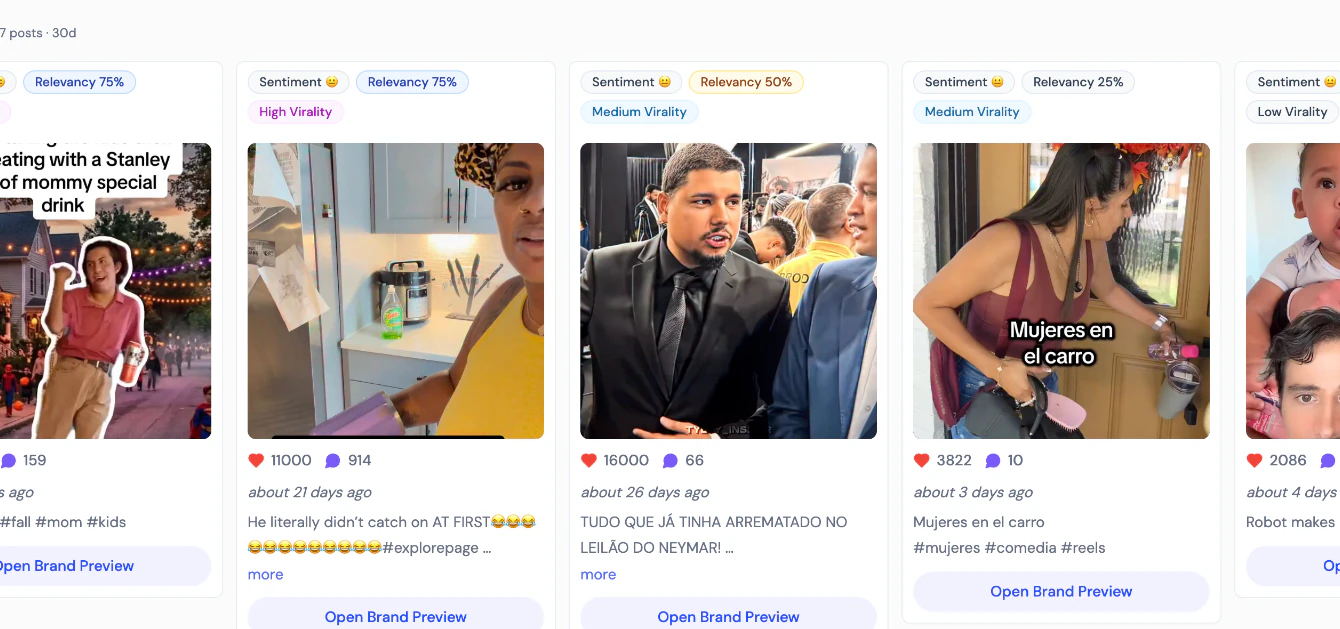
Take the Halloween Reel from earlier. A caption search for Stanley would never surface it. Sociable AI picks it up and marks the exact second the tumbler appears.
Set up your searches
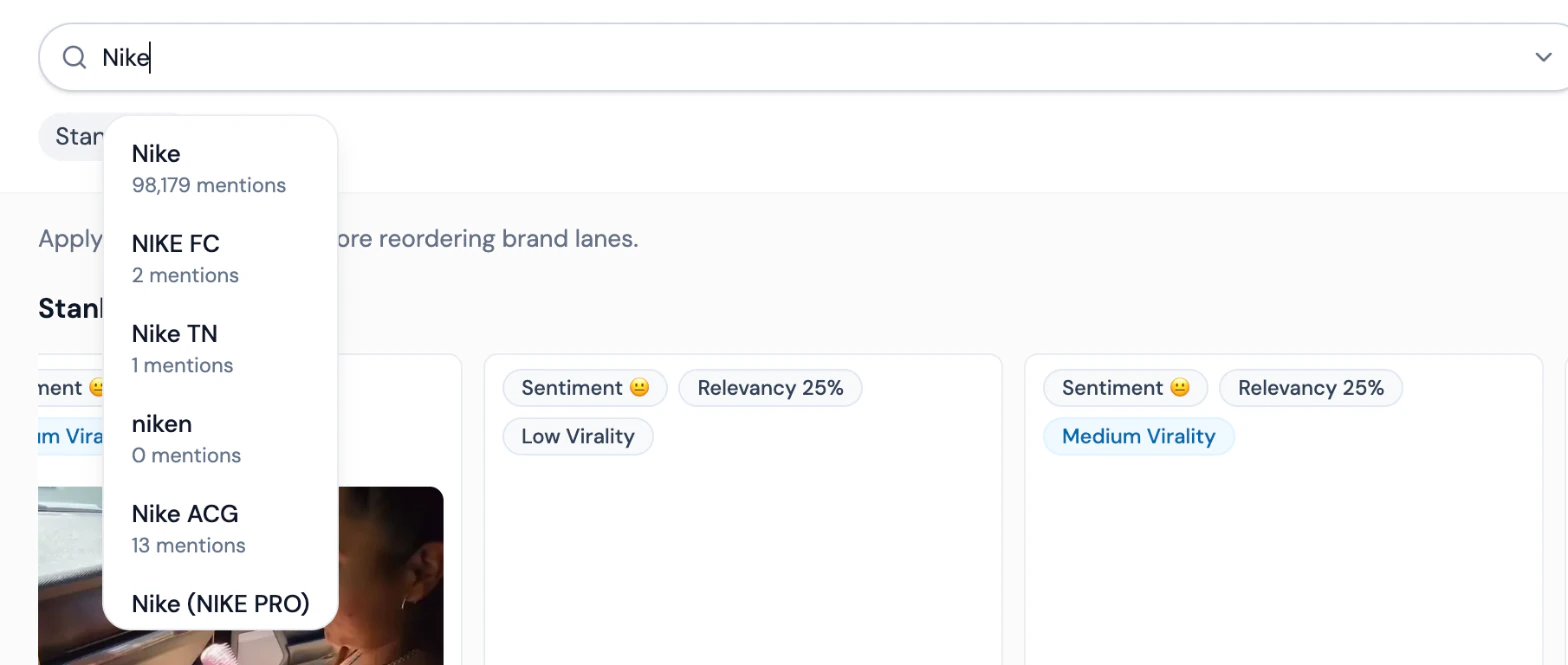
Set up searches for your brand name and the misspellings people use, your product names, your competitors' names, and two or three category terms.
Act on what you find
Reply to the feedback, reach out to the creators you want to work with, and comment on the posts that feature your brand. For each Reel it finds, Sociable AI drafts a few comments in your brand's voice, and you pick one and post it.
Instagram social listening tools and what each one is good for
Sociable AI finds the Reels where your brand appears, even when the caption never names it, and shows you who the creator is and how the post is performing. It fits brand mention tracking and creator discovery, and it drafts comments for the posts it finds. AI social listening is included on the Scale plan at $1,740/mo.
Brand24 is keyword and hashtag mention tracking with sentiment, and it is the cheapest paid entry point on this list. The Individual plan is $249/mo billed monthly or $199/mo on annual billing, for 3 keywords and 2,000 mentions a month, with a 14-day free trial. It suits a small team watching brand and competitor names across several platforms at once. Brand24 is text-based, so it cannot see a product in a video that the caption did not name.
Sprout Social puts listening inside a full social media management suite, and its reporting is strong. If your team already publishes and replies in one tool, this is the natural place to add listening. Listening is an add-on available on the Standard plan and up, and Standard is $199 per seat per month on annual billing. The add-on price is not published, and per-seat pricing adds up quickly for a team.
Meltwater is enterprise listening with deep history and dashboards, and it is the right pick for an insight team with budget and an analyst to run it. Pricing is tailored by quote rather than listed. Instagram is one source among many in Meltwater.
EmbedSocial collects tagged mentions, hashtag posts, and user-generated content, with rights requests built in, which suits a UGC program. Instagram mentions and social listening are included from the Pro Plus plan at €49/mo. EmbedSocial only sees mentions that were tagged.
Get your comment in while the Reel is still climbing
Listening tells you where your brand is showing up. The next step is being part of that conversation while it is still happening, and on Instagram that means commenting early. In our data, comments left in a Reel's first hour earned about three times the likes of comments left a few hours later. Sociable AI users have earned nearly 1.4 million likes this way, reaching well past their own followers with nothing more than a comment.
Sociable AI monitors Reels across your niche in their first hours and flags the ones likely to go viral, including the ones that show your product without naming it. We draft a comment that fits the post, you approve it, and the comment goes up while the Reel is still climbing.
Try Sociable AI and find your brand's untagged mentions while there is still time to do something with them.
FAQ
Is there a free way to do social listening on Instagram?
Yes. A professional account's Tagged and Mentions views, hashtag follows, and keyword search inside the app cover everything people tagged and give you a manual sample of everything else. The free options run out when you need alerts, exports, or any way to find the mentions that never used your name.
What's the difference between social listening and social monitoring on Instagram?
Monitoring collects what is aimed at you, such as tags, mentions, and comments on your posts. Listening covers every post that references you, including the ones that never tagged you.
Can a social listening tool see Instagram Stories or DMs?
No. Meta does not make Stories available to tools, and no tool can read private accounts or DMs. What a tool can see is public posts and Reels, their captions and comments, and, if it looks at the video, what is in it.
Why doesn't a keyword search find most Instagram mentions?
On Instagram, a mention is usually something in the video, like a product in the shot or a name said aloud, and the caption often does not include it. A word search only finds the caption.
What should a small brand track first?
Your own brand name and the misspellings people use, plus one competitor. Add nothing else until that is working and someone on the team is acting on what it finds.