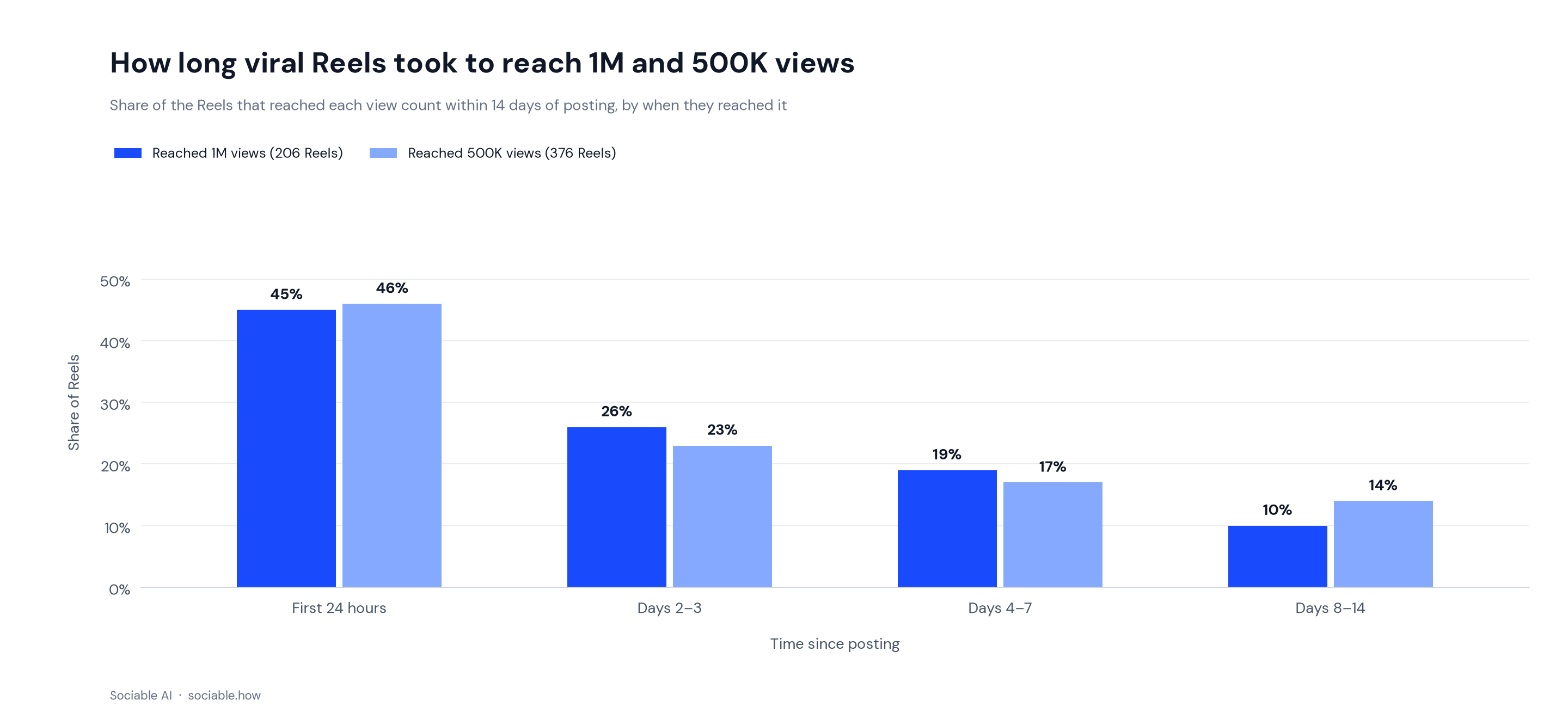
How long does it take for a Reel to go viral? In our tracking of 4,724 trending Instagram Reels, about half of the Reels that reached 1 million views did so within a day of posting, about a quarter did so on days 2 and 3, and only about one in ten took longer than a week.
We defined viral as 1 million views for this study. We also ran the same analysis for 500,000 views, which is the most common viral benchmark for Instagram, and the timing for 500,000 views was nearly the same.
Our numbers come from 4,724 trending Instagram Reels collected between March 2025 and May 2026. We followed each Reel for up to a month and checked its view count roughly once a day. Because we also tracked Reels that never reached 1 million views, we can tell you the view count below which a Reel was very unlikely to go viral. We'll start with how long the viral Reels took.
How long viral Reels took to reach 1 million views
Most viral Reels reached 1 million views within a few days of posting, and very few needed more than a week. Of the 2,016 Reels we tracked for at least two weeks, 206 reached 1 million views and 376 reached 500,000 views in that time. The chart below shows how long those Reels took to reach each view count, and the table underneath gives the exact shares.
| Reached during | 1M views (206 Reels) | 500K views (376 Reels) |
|---|---|---|
| First 24 hours | 45% | 46% |
| Days 2–3 | 26% | 23% |
| Days 4–7 | 19% | 17% |
| Days 8–14 | 10% | 14% |
The median Reel took about a day and a half (1.4 days) to reach 1 million views, and about a day (1.1 days) to reach 500,000 views.
As you can see, most viral Reels went viral in their first few days. If you add the first two rows together, about seven in ten of the Reels that reached 1 million views had reached it by the end of day 3, and nine in ten had reached it by the end of the first week. The 500,000 column follows almost the same pattern.
Though, going viral was rarely a matter of hours. Almost none of the Reels reached 1 million views within six hours of posting, and only about 7% of the Reels that reached 500,000 views did so within six hours.
What a viral Reel looks like in its first few days
Reels that went viral already had a lot of views after one day, and their views kept growing quickly for longer than the views of other Reels did. Those two patterns explain why you can tell so early whether a Reel will go viral.
Let's start with the first day. Reels that reached 1 million views within two weeks had a median of about 650,000 views 24 hours after posting, and the middle half of those Reels had between roughly 410,000 and 1.2 million views. Reels that reached 500,000 views within two weeks had a median of about 420,000 views at 24 hours. In other words, viral Reels rarely started with a small view count and climbed slowly.
The second pattern is that every Reel's views grew more slowly each day, but the slowdown came later for viral Reels. To show this, we grouped the 2,016 Reels by how many views each Reel had 14 days after posting. The table shows how fast the views in each group grew per day.
| Views after 14 days | Daily growth in views, day 1 to 2 | Day 2 to 3 | Day 3 to 5 | Day 5 to 7 | Day 7 to 14 |
|---|---|---|---|---|---|
| Under 100K | 80% | 17% | 6% | 3% | 1% |
| 100K–500K | 92% | 26% | 9% | 4% | 2% |
| 500K–1M | 93% | 29% | 9% | 5% | 2% |
| 1M+ | 100% | 44% | 15% | 6% | 3% |
In every group, views roughly doubled between day 1 and day 2. After the first week, views in every group grew by only a few percent a day. The biggest difference between the groups is from day 2 to day 3, when Reels that ended above 1 million views still grew 44% and Reels that ended below 100,000 views grew 17%. Even so, growth slowed for the viral Reels too. By about day 9, the Reels that ended above 1 million views already had most of the views they would have on day 14.
So there is no single day when a Reel stops getting views. However, growth slows down so predictably that a Reel's view count after two or three days tells you a lot about how many views the Reel will end up with. A separate Socialinsider study of 40 million Instagram Reels found a similar pattern, with Reels averaging the most views in their first five days.
When can you tell a Reel won't go viral?
Since a Reel's early view count tells you so much, we can work out the point at which a Reel is very unlikely to go viral. A Reel with fewer than about 250,000 views three days after posting had almost no chance of reaching 1 million views within two weeks.
To find that number, we looked at Reels that had not yet reached 1 million views 1, 2, 3 and 7 days after posting, and grouped those Reels by how many views each Reel had on that day. Each cell in the table below shows how many of the Reels in that group reached 1 million views by day 14. For example, 140 Reels had between 100,000 and 250,000 views on day 3, and only 1 of those 140 Reels reached 1 million views by day 14.
| Views on that day | Day 1 | Day 2 | Day 3 | Day 7 |
|---|---|---|---|---|
| Under 100K | 3 of 468 | 1 of 363 | 0 of 297 | 0 of 402 |
| 100K–250K | 8 of 133 | 4 of 146 | 1 of 140 | 0 of 227 |
| 250K–500K | 16 of 64 | 1 of 56 | 4 of 85 | 1 of 106 |
| 500K–1M | 21 of 28 | 20 of 36 | 18 of 40 | 11 of 59 |
On day 1, Reels with fewer than 1 million views still had a real chance of reaching it. Reels with 500,000 to 1 million views on day 1 reached 1 million views three times in four (21 of 28), and Reels with 250,000 to 500,000 views reached it one time in four (16 of 64). By day 3, the chances were much lower. None of the 297 Reels under 100,000 views on day 3 reached 1 million views, and only 1 of the 140 Reels between 100,000 and 250,000 views did. By day 7, a Reel needed more than 500,000 views to have a realistic chance. Of the 735 Reels below 500,000 views on day 7, only 1 reached 1 million views by day 14.
If your benchmark is 500,000 views, the equivalent number is about 100,000 views on day 3. None of the 297 Reels below 100,000 views on day 3 reached 500,000 views by day 14, and only 2 of the 140 Reels between 100,000 and 250,000 views did. On day 7, no Reel below 250,000 views went on to reach 500,000 views.
These numbers also tell us whether a Reel can go viral several days after posting. A Reel can, since about half of the Reels that reached 1 million views did so after their first day. However, the Reels that reached 1 million views later were nearly always close to 1 million views already. For example, 18 of the 40 Reels that had between 500,000 and 1 million views on day 3 reached 1 million views by day 14. It was very rare for a Reel with a low view count on day 3 to reach 1 million views later.
Keep in mind that these view counts come from Reels posted by accounts of all sizes. If you run a small account, a Reel with far fewer views can still be viral for your account. We cover how smaller accounts can use these numbers in the FAQ below.
What to do when your Reel stops growing
It's discouraging to watch a Reel's views slow down after a couple of days. Though, if your Reel is more than three days old and its view count is well below the numbers above, the best use of your time is to work on your next Reel and apply what this Reel taught you. Here's what we recommend.
- Don't wait for the Reel to take off later. After the first week, even the Reels that ended above 1 million views were growing by only about 3% a day.
- Don't delete the Reel because of these numbers. Leaving the Reel up costs you nothing.
- Compare the Reel with your own previous Reels. Look at how many views this Reel had one day and three days after posting, and compare those numbers with your previous Reels at the same points. That comparison shows whether the Reel did well for your account. Then change one thing in your next video. The opening is a good place to start, so try a different viral hook strategy and keep the rest of your format the same.
See what goes viral in your niche with Sociable AI
Since you can usually tell within a few days whether a Reel will go viral, the most valuable work happens before you post. Waiting does very little for a Reel whose views have already slowed down, but you have full control over what you post next. The best reference for your next Reel is a set of Reels on your subject that actually went viral.
Sociable AI Search helps you find short-form videos by what is shown, said, worn, used or mentioned in them, and you can filter the results by how viral each video is. For example, you can search for your topic, filter down to the most viral results, and study how those videos open and what they promise viewers in the first few seconds.
Try Sociable AI Search before you plan your next Reel, and start from examples that have already gone viral in your niche.
Frequently asked questions
Can a Reel go viral after a week?
A Reel can go viral after a week, but it rarely happened in our data. About one in ten of the Reels that reached 1 million views did so in the second week, and those Reels almost always had more than 500,000 views by day 7. Of the 735 Reels below 500,000 views on day 7, only 1 reached 1 million views by day 14.
Can a Reel go viral months later?
Some people do report a Reel going viral months later. For example, Diane Hill writes that "Reels can go viral weeks or months after being posted, this has happened to me". In our data, though, views grew by only 1% to 3% a day after the first week, for viral and non-viral Reels alike. We'd treat a Reel going viral months later as an exception and wouldn't plan around it.
Is the timeline different for small accounts?
Our Reels came from accounts of many sizes, so the same pattern should apply to a smaller account. Viral Reels had high view counts on their first day, and growth slowed within a week. Instead of using the view counts above, compare your Reel with your own previous Reels at the same number of days after posting.
Do trial Reels follow the same timeline?
Trial Reels are shown to non-followers first. Instagram's Help Center says that insights on a trial Reel appear within 24 hours of sharing. Meta's 2024 launch announcement also described optional automatic sharing of a trial Reel "based on the views it receives within the first 72 hours." Both time periods are for evaluating the trial, and neither is a deadline for going viral. Still, both periods fit our finding that the first few days after posting matter most.