Social listening tools monitor online conversations across channels to track brand mentions, sentiment, and emerging trends in real-time. They aggregate data from social media, forums, and review sites to surface consumer insights, competitive intelligence, and community signals that inform marketing strategy and product decisions. Brand monitoring, by contrast, focuses narrowly on protecting reputation by catching mentions of your brand name and immediate competitors, a defensive posture rather than a discovery engine.
The gap between the two is widening in 2026. Brands that rely only on brand monitoring miss the sentiment shifts happening in adjacent conversations, niche communities, and emerging trend clusters where customers discuss problems your product solves without mentioning your name.[1] Social listening captures those signals; brand monitoring ignores them.
The difference isn't semantic, it's strategic. Here's where they diverge in practice, and why your tech stack needs both.
TL;DR
- Brand monitoring catches direct mentions; social listening uncovers demand signals competitors miss
- AI-powered listening identifies emerging conversation patterns before they trend, enabling faster response
- Combining both approaches increases actionable insights versus monitoring alone
Social Listening and Brand Monitoring Solve Different Business Problems
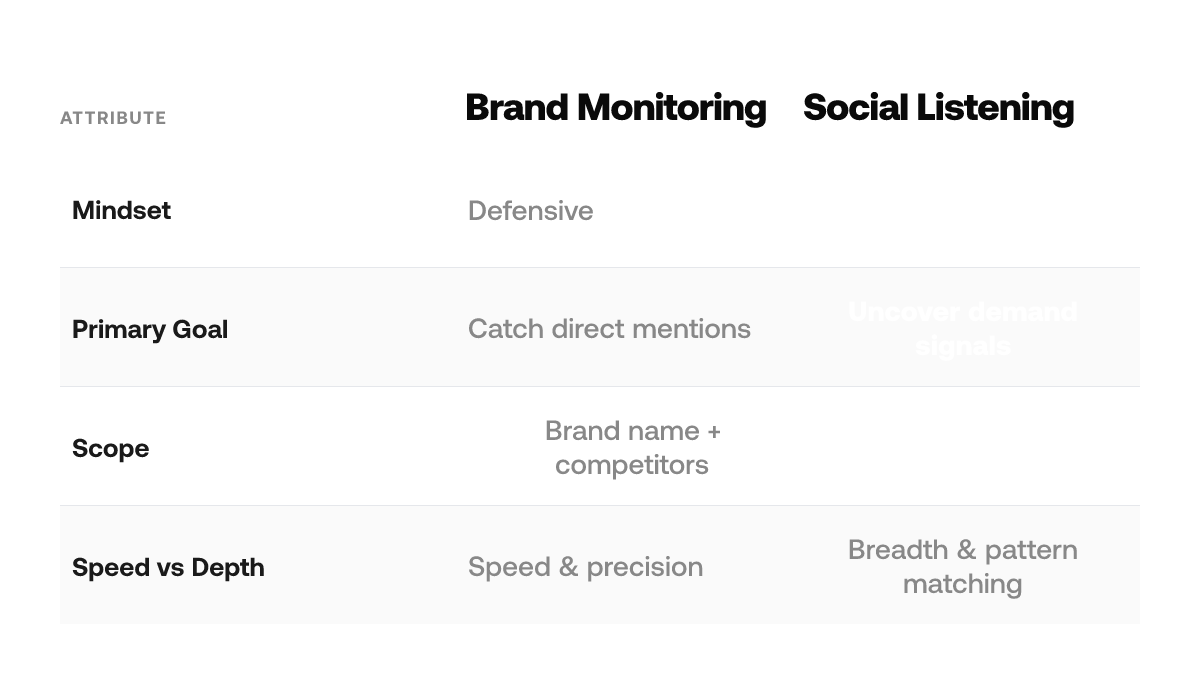
Brand monitoring and social listening aren't interchangeable, they're opposite sides of the same coin. Brand monitoring is defensive. It tracks your mentions, competitor activity, and customer service signals. Social listening is offensive. It discovers unmet needs, emerging trends, and conversations happening in spaces where your brand isn't mentioned yet.
The operational mindsets are fundamentally different. Monitoring is compliance-driven: alert me when my name appears, when sentiment shifts, when a crisis surfaces. Listening is discovery-driven: show me what people actually want, where pain points cluster, what categories are trending before they saturate.
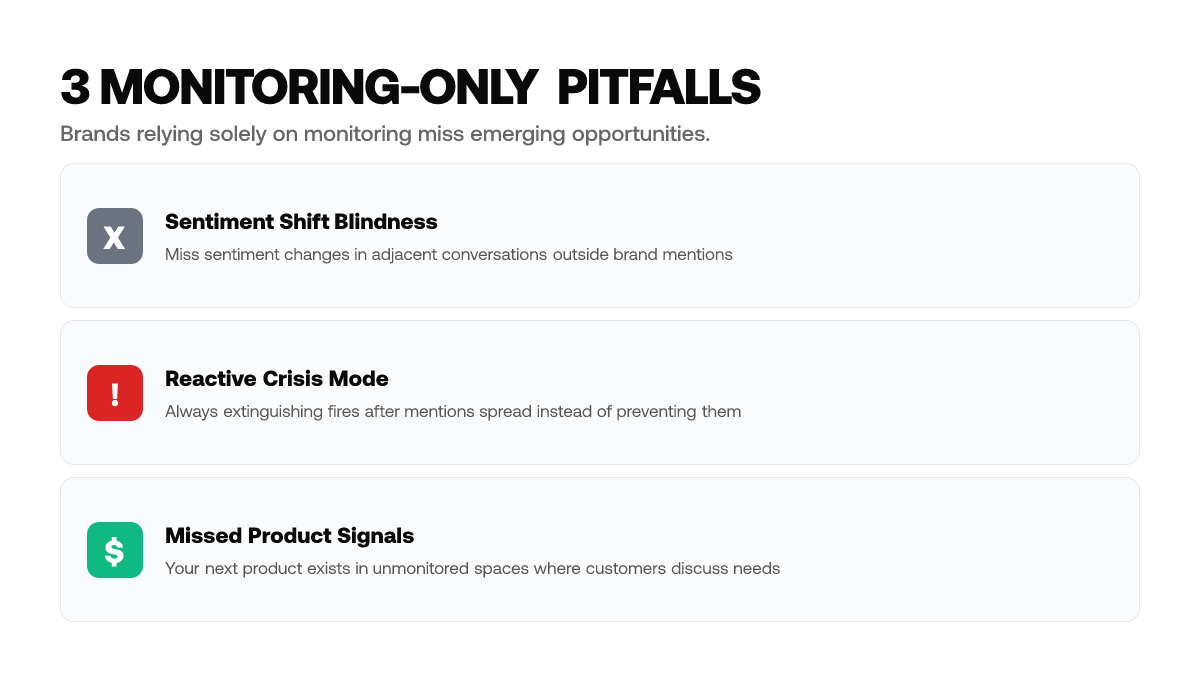
Most brands treat these as interchangeable functions, then wonder why they're always reactive. Your team ends up doomscrolling through dashboards, reacting to mentions after they've already spread, drafting responses instead of spotting opportunities three months before competitors do. You're stuck in defense mode, extinguishing fires instead of building the product your audience actually needs.
Here's the thing: companies that pay for both tools often run them through the same team, creating a structural conflict. The person managing brand alerts at 10 a.m. isn't the same person discovering emerging category trends at 2 p.m. One requires speed and precision. The other requires breadth and pattern recognition across platforms and time periods.
Key insight: The missed opportunity gap happens when brands optimize for monitoring alone. You'll catch every mention of your brand name, but you'll miss the conversations where your next product already exists, waiting to be built.
For the social media manager, monitoring keeps you from getting blindsided. Listening keeps you from getting left behind. Monitoring integrates with Slack alerts and real-time dashboards. Listening requires historical data mining, sentiment analysis, and cross-platform pattern detection, the kind of depth that tools like Sociable AI handle through AI-powered NLP to surface intent signals you'd never catch manually.
For the brand strategist, monitoring tells you what's breaking. Listening tells you what's breaking through. One is tactical noise management. The other is strategic foresight.
When these workflows live in separate systems with separate teams and separate reporting cadences, your brand stops leaving money on the table.
How AI-Powered Social Listening Uncovers Signals Brand Monitoring Misses
AI-powered social listening detects intent signals, emerging needs, and emotional language long before they become search queries or brand conversations. Brand monitoring is keyword-reactive, it catches mentions of your brand or competitors by name. Social listening is pattern-reactive, it catches the problem conversations happening right now, before customers even know what product solves them.
When someone on Reddit writes "I can't sleep because my mind won't stop racing" or posts on TikTok about "natural ways to calm anxiety at night," they're not mentioning brands or product categories yet. They're describing a pain point. Traditional keyword monitoring misses this entirely because it's listening for exact terms like "sleep supplement" or "adaptogen brand X." By the time those keywords trend, competitors have already noticed.
Natural language processing (NLP) algorithms do something different. They identify semantic intent, the meaning beneath the surface words. An AI listening tool recognizes that "racing thoughts before bed," "can't shut off my brain," and "wired but exhausted" all point to the same underlying problem: sleep anxiety related to mental overstimulation. Sentiment analysis layers on top, revealing emotional intensity. A frustrated, urgent tone signals higher motivation to solve the problem than casual curiosity.
Here's a real example: a wellness brand deployed AI listening across Reddit, TikTok, and wellness forums in early 2026 and noticed a growing conversation cluster around adaptogens specifically for sleep anxiety, distinct from general sleep talk. The brand saw conversation volume and emotional intensity rising months before major competitors launched their own products in this space.[1] This first-mover window existed only because the brand listened for the problem pattern, not the product category.
Keyword-based monitoring will never see this coming. It's blind to conversations that don't yet use branded or categorical language. AI listening catches the conversation before it becomes a product conversation, which requires different alert structures, broader data sources, and pattern-recognition models instead of exact-match dashboards.
Building a Tech Stack That Separates Listening from Monitoring Workflows
The mistake most teams make isn't choosing the wrong tool, it's forcing one tool to do both jobs. When a single platform handles brand monitoring and social listening, it prioritizes speed (the core strength of monitoring) over pattern recognition (the core strength of listening). You get fast alerts but miss insights hiding in unstructured conversation data across platforms.
Monitoring and listening demand different architectures, alert cadences, and permission structures.
Monitoring Tools: Built for Speed and Precision
Brand monitoring requires exact-match triggers, rapid escalation, and a narrow scope. You're tracking mentions of your brand name, competitor activity, customer service complaints, and defined keywords. The workflow is linear: mention detected → alert fired → human responds.
Single-platform tools work well here. A Twitter/X integration with Slack, a Reddit mention tracker, or a native platform dashboard gives you sub-minute latency on defined keywords. Most cost a few hundred dollars monthly for small-to-mid teams. The speed is the feature, but here's the constraint: monitoring tools are built to ignore context. They miss sentiment nuance, cross-platform patterns, and conversations where your brand name never appears.
Listening Tools: Built for Breadth and Signal Detection
Social listening covers six or more platforms simultaneously and surfaces trends you're not explicitly searching for. It detects sentiment shifts, identifies emerging keywords, segments audiences by demographic and intent, and flags category conversations happening without your brand mentioned at all.
This requires different infrastructure. Enterprise listening suites ingest data from Twitter, Instagram, TikTok, Reddit, Discord, LinkedIn, and YouTube at once, apply natural language processing to detect intent and emotion, and surface patterns humans would miss. Cost scales with data volume and team size, but the payoff is strategic foresight instead of reactive response.
The Decision Matrix
| Use Case | Tool Type | Platform Scope | Budget Range |
|---|---|---|---|
| Customer service escalation, competitor tracking, crisis detection | Single-platform or native integrations | 1-2 platforms | $500–2,000/month |
| Trend discovery, audience segmentation, category insights, competitor whitespace | Enterprise listening suite | 6+ platforms with cross-platform correlation | $3,000–15,000+/month |
The monitoring budget is predictable. The listening budget scales with ambition, larger datasets and deeper historical analysis cost more, but they also compound strategic advantage over time.
Separate Alert Cadences, Separate Dashboards
Once you've chosen tools, treat their outputs differently. Monitoring alerts should trigger immediately in Slack or email, sub-five-minute response time on brand mentions and service complaints. These are operational; a community manager or customer service rep acts on them in real time.
Listening insights move slower. Weekly or bi-weekly reports work better because the value is in pattern recognition, not reaction speed. A trend that emerges over days deserves deeper analysis before product or marketing teams act on it. Listening dashboards should surface the "why" behind sentiment shifts and emerging keywords, not just the "what."
Pro tip: If your monitoring tool triggers 50+ daily alerts and your listening dashboard surfaces 5 trend insights per week, blending them into one channel creates noise that buries the signal. Keep workflows separate; merge outputs in monthly strategy reviews.
This separation prevents alert fatigue while preserving the ability to drill into patterns when they matter. Your team will actually read the insights instead of tuning them out.
Frequently Asked Questions
Can a single tool handle both brand monitoring and social listening?
In most cases, you'll get better results with separate tools. Brand monitoring needs speed and precision (alerts within minutes of a mention spike), while listening needs breadth and pattern recognition across six-plus platforms. Tools like Sprout Social or Hootsuite do both adequately but neither exceptionally. For teams under 50 people, a focused monitoring tool ($500-2K annually) plus a dedicated listening platform ($3K-8K annually) often delivers better ROI because you're not paying for bloat in either direction.
Why would a brand discover trends faster with social listening than by monitoring competitor activity?
Monitoring tells you what competitors are saying and how loudly. Listening shows you the entire market they're trying to own. When you monitor "Competitor X launches sleep supplement," that's useful. When you listen to "adaptogens for sleep anxiety" across Reddit, TikTok, YouTube, and blogs, you see conversation spikes, discover which audience segments are underserved, and identify which channels matter most, before your competitor enters.[1] Monitoring is reactive defense. Listening is offense.
If I'm a small community manager with limited budget, should I skip listening?
Skipping listening means you'll stay reactive forever, commenting on trends after they peak, reacting to customer service issues instead of preventing them, and watching faster competitors claim opportunities you missed. Start with a single-platform listening tool (Twitter/X or TikTok API integrations run $500-800 annually) to test patterns in your core community, then layer monitoring alerts on top. You don't need enterprise suites to unlock listening, you need focused data and NLP that catches intent shifts.
How does NLP and sentiment analysis surface pain points that keyword monitoring misses?
Keyword monitoring catches "I hate this product," but NLP-powered listening catches "It works okay but I wish it did X" (unmet need signal) and "This is similar to Y but more expensive" (category conversation without your brand). Sentiment analysis detects emotional language patterns, frustration, resignation, hope, that predict which problems customers will pay to solve. "I've tried everything for sleep anxiety" shows different intent than "Nothing works for sleep anxiety." Basic tools flag both as negative mentions. Listening tools distinguish which represents market opportunity.
Should I integrate monitoring alerts into Slack but keep listening in a separate dashboard?
Yes. Monitoring alerts land where your team is, Slack, email, SMS, because they're escalation triggers (mention spike detected, competitor announcement, customer complaint). Listening insights are artifacts you analyze weekly or monthly (trend reports, sentiment shifts, emerging subcategories), so a centralized dashboard or Google Sheets export works better. This prevents Slack alert fatigue while preserving the ability to drill into patterns.
What's the difference between monitoring competitor mentions and listening to their category conversations?
Monitoring competitor mentions tells you what they're saying. Listening on category conversations shows you the entire market they're trying to own. When you monitor "Competitor X launches sleep supplement," that's useful. When you listen to "adaptogens for sleep anxiety," you see conversation growth, discover underserved audience segments, and identify which channels matter, before competitors enter.[1] You need both, but listening gives you the market intelligence that lets you move first.