Social media community management is the ongoing work of finding, handling, and learning from conversations around a brand on public social platforms. There are two main ways of engaging with these conversations.
The first is reactive engagement in comments, mentions, and messages directed at the brand or taking place around its own accounts. The second is proactive participation in relevant conversations happening elsewhere. A community manager might respond to a product question under a brand post, then contribute to a conversation in another creator's comments section that reaches a different audience.
Social media community management overlaps with several other adjacent roles in the marketing industry, but it is not interchangeable with them. Content publishing creates the material people respond to. Broader social media management may also include planning, publishing, paid campaigns, and reporting. Customer support handles service outcomes, while community moderation enforces participation rules.
Community management connects those functions through conversation. To build an effective community management strategy, you need to decide which conversations matter and what each engagement is meant to achieve. Without that decision to guide your strategy, your team can respond quickly and frequently without knowing whether or not the work is actually doing anything, since outcomes can range from building trust to protecting reputation, generating insight, or helping the brand reach new people.
What Social Media Community Management Should Achieve
As we just mentioned, social media community management can influence several outcomes. It can help build audience trust, answer support questions, protect reputation, reveal recurring customer concerns, encourage participation around owned content, increase discovery beyond an existing audience, and turn conversations into conversions.
The most common outcome associated with social media community management is an increase in post engagement. That is to say, more people interact with your posts, which sends positive signals to social media ranking algorithms and also encourages additional engagement from others. There is measured evidence of an association between replying to comments under your posts and post engagement. Social Media Today described such research, done by Buffer, as “analyzing engagements with over 2 million posts, across various platforms, to see whether responding to people actually helps to increase post engagement as a result.” Social Media Today reported that “posts in which the creator has replied to comments see 42% more engagement overall, based on Buffer’s analysis.”
This result should not be treated as a guarantee that replying causes a fixed increase for every account. Julian Winternheimer provided an important qualification when Buffer quoted him in the original study saying, “When creators engage back in their comments, their posts perform better relative to their own baseline,”. Therefore the comparison being done is against the creator’s existing performance, not a universal standard applied across unrelated brands.
All this is to say, your team should begin by choosing one primary and measurable objective. A reputation strategy and a discovery strategy will not prioritize the same conversations or discern success using the same metrics. The selected strategy determines which conversations matter, how those conversations should be handled, and what the team should measure.
A Decision Framework for Social Media Community Management
Once your primary objective is clear, your team can build an operating method around it. The method should function as a general guide, not necessarily a strict rulebook on how to handle every type of engagement.
-
Select the primary objective. Define what progress would look like before collecting activity metrics. A support objective might focus on customer problem resolution. A discovery objective might focus on qualified engagement from people beyond the existing audience. The metrics should have a clear relationship to your selected outcome.
-
Map conversation sources. Include comments on owned posts, mentions, direct messages, brand and category discussions, relevant creator conversations, and emerging public posts. This map shows where conversations happen and prevents the team from focusing all of their attention in one place and missing out on conversations in others.
-
Decide what deserves attention. Evaluate each conversation according to relevance, intent, risk, and opportunity. For example, a detailed buying question usually deserves more attention than a generic reaction. Or consider a more complex scenario, where a complaint with reputational risk may take priority even when the complaint has little immediate commercial value.
-
Set response windows. Do not apply one daily (or worse, weekly) deadline for all of your interactions. Sprout Social reported that nearly 75% of customers wanted brands to respond within 24 hours or less. More specifically, Emplifi reported a measured typical brand response time of 5.4 hours on Instagram. While neither figure establishes a universal service expectation, they are good references for what your audience is likely expecting. Though, expected response times also vary based on conversation context. A complaint, a casual comment, and an external cultural conversation carry different levels of urgency.
-
Define voice and permissions. Document how the brand should sound, which claims can be made, and who should be responsible for approving sensitive responses. Your approval rules should reflect associated risks. A routine acknowledgement may follow a standard process, while legal, safety, or high-profile issues may require specialist review.
-
Choose the correct action. Your options include replying publicly, moving the conversation into a DM, escalating internally, moderating harmful content, using automation, or deliberately leaving the conversation alone. Not every mention requires a response. The team should know when silence is safer or more appropriate.
-
Collect metrics. Connect every metric to the original objective. Response time may matter for service interactions, while proactive participation requires evidence that the brand reached and engaged relevant people. While large activity count is good to see, it's not proof of progress unless the activity served the objective.
Now we've built an operating system for choosing and handling conversations. With this system in mind, we can now discuss in depth the two major types of social media community management. Remember to keep these steps in mind as we continue, asking yourself questions like "what are the relevant conversation sources in this context?" and "what should the ideal response window be for this kind of engagement?".
Reactive Community Management: Comments, Mentions, and DMs
Reactive engagement begins with activity directed at or around the brand. A typical workflow looks like collecting comments, mentions, and messages, classifying each interaction, setting its priority, drafting a response, approving or escalating it, and then responding in public or continuing the conversation in a DM. Recurring questions and feedback should be recorded so the team can learn from the issue rather than handling the same issue from scratch indefinitely.
Classification is important because ordinary engagement, service questions, complaints, sensitive issues, spam, and buying intent should not be handled the same way. A positive comment may need a brief acknowledgement. A technical question may require information from a support team. Spam may need moderation rather than engagement. A sensitive complaint may require internal review before the brand says anything publicly.
Buying intent creates another path. Let’s say someone asks whether a product is available in their country. Your public response can acknowledge the question, while a DM can continue the conversation using information specifically relevant to that person. Moving into a private channel also prevents the public thread from becoming overloaded with account details or other personal information.
Speed remains important, particularly when someone needs help or a public complaint is gaining attention. However, a fast response that is inaccurate, generic, clearly automated, or inappropriate to the risk can make the situation worse. Your objective should not be to clear the inbox as quickly as possible. Your objective is to provide a useful response through the correct channel.
A purely reactive engagement strategy still has a limitation. Reactive engagement serves people who have already found, mentioned, or contacted the brand. You're only engaging with people who already know who you are. So next we'll explain how social media community management can also help the brand participate in conversations beyond that existing audience.
Proactive Community Management Beyond Your Own Accounts
Brands can take part in relevant conversations outside their own accounts. Zaria Parvez, Senior Global Social Media Manager at Duolingo, described the role of external participation when quoted by Talkwalker saying, “Our first success wasn't creating videos—it was commenting on other people's content,”.
It is important to acknowledge that Parvez's comment reflects practitioner experience rather than measured proof. However, her shared experience is an important testimonial to why community management should not stop at the boundary of the brand’s own profile. Relevant external conversations give brands an opportunity to be useful, recognizable, or entertaining before someone has chosen to follow them.
A typical proactive community management workflow follows six steps.
-
Define the relevant territory. Identify topics, accounts, products, creators, and cultural conversations where the brand has a legitimate reason to participate. Relevance may come from expertise, audience overlap, customer interest, or a natural connection to the brand.
-
Find suitable conversations. Look for emerging posts and active discussions where a contribution could add something. Effective outbound comment marketing depends on finding conversations early enough for other people to see the response.
-
Choose the best response type. The brand might offer a specific observation, answer a question, make a contextual joke, connect the discussion naturally to the brand, or use a visual response when a GIF communicates the idea more effectively than text.
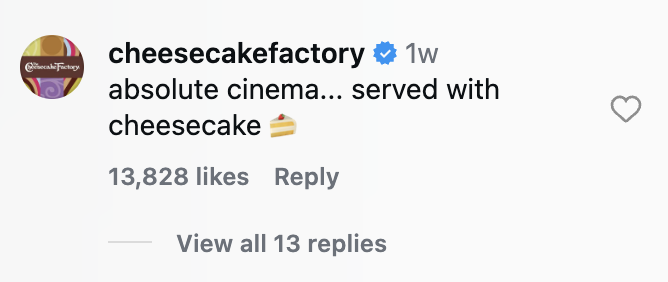
Your response type should change based on the post. Check out these examples from the brands below. They range from a three-word reaction with a funny emoji to a full thought out reply.
Short reactions
The Cheesecake Factory turns the familiar phrase “absolute cinema” into “absolute cinema… served with cheesecake.” The comment is short, but the product reference fits the original joke rather than interrupting it.
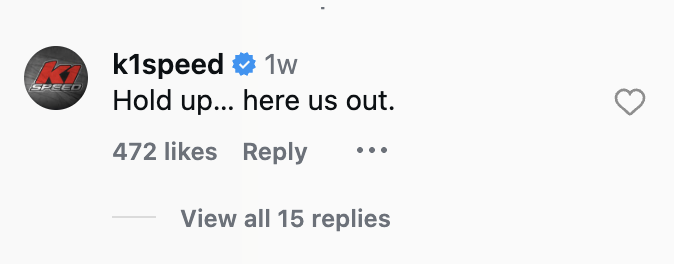
K1 Speed similarly references the familiar phrase “hear me out”. Their comment withholds any actual observation and allows readers to make the funny connection themselves.
Specific observations
Market comments, “Can’t believe you interrupted his song,” reacting in a relatable way to an identifiable moment in the post.

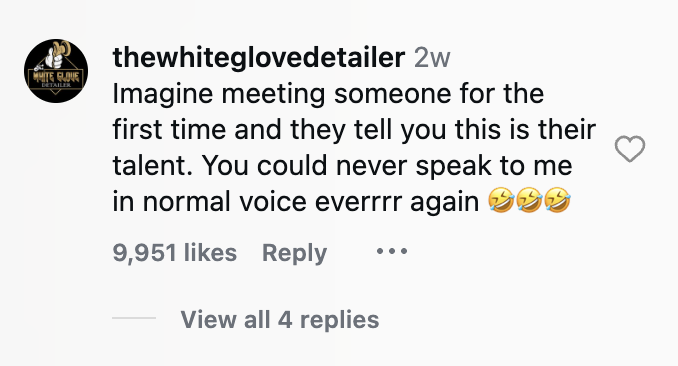
The White Glove Detailer also goes for relatability in this top comment.
Emojis and GIFs
Google Gemini compresses its reaction into “butcher said:” followed by motorcycle and smoke emoji. You're expected to understand the reference without an explanation, which is funny once you understand what they're trying to say.

Teufel Audio removes written copy altogether and responds with a reaction GIF.

As you can see, the brands who do this successfully are engaging organically, trying to be funny and relatable to provide value to the comments section. There's no one right way to do it, just be creative!
-
Review relevance and risk. Check whether the response fits the original post, sounds appropriate for the brand, and could be misunderstood outside its immediate context. A joke that works in one community may appear insensitive or forced in another.
-
Participate while the conversation is active. External participation loses much of its value when the audience has already moved on. The appropriate window depends on how quickly the post is gaining attention and whether the discussion is still developing.
-
Track the outcome. Not every proactive comment will earn attention. Results should be assessed across a meaningful body of work rather than by selecting only the most successful examples.
What 10,000+ Outbound Comments Reveal About Timing and Engagement
Proactive participation creates an obvious measurement question. How often do outbound comments receive meaningful engagement, and how much does timing matter?
To answer these questions, Sociable AI has tracked over 10,000 comments placed on Instagram between March 2025 and August 2026. It is important to note that the accounts that placed these comments are not a random sample of Instagram.
The engagement distribution is highly skewed. We observed 1,396,064 likes earned across the 10,000 comments, but the median comment received 1 like. Out of the entire set of tracked comments, 18.9% reached at least 10 likes and only 6.1% reached at least 100 likes.
Timing showed a clear association with the share of attention a comment captured. We found that comments posted within the first hour captured 0.1089% of the parent post’s likes at the median. Comments placed between 1 and 4.4 hours later captured 0.0332% at the median. The first-hour median was 3.3 times higher.
These data surface an important question for social media community management teams. How a team can maintain relevant coverage, timely participation, and sound judgment across both reactive and proactive strategies as the volume of possible conversations grows?
What to Automate and Where Human Judgment Still Matters
Automation can support several parts of the operating method. Discovery systems can surface emerging conversations. Classification can separate routine engagement from buying questions, complaints, spam, and high-risk issues. AI can draft responses for review, while repetitive inbound questions can be automatically answered with established handling rules. DM automation can continue suitable conversations, and escalation rules can route exceptions to a person.
It is important to consider the different ways of handling automation within a specific use case. For example, consider automated DM systems. Fixed chatbots follow predetermined branches based on selected options, keywords, or known conditions. AI-led conversations adapt to what the person actually says while moving toward objectives defined by the business. While fixed flows can provide consistency for predictable tasks, AI-led handling can be more flexible when the language or path varies.
Meta executive Dan Levy provided one estimate of the potential scope for automation when quoted by AdExchanger saying, “You can take care of somewhere between 50% and 70% of queries through an automated system.” A hybrid model, which is what Levy is referring to, is the best choice for community management teams that want to operate efficiently while maintaining quality.
Customer expectations also support a hybrid model. Gartner reported results from a survey of 3,566 B2B and B2C customers conducted in February and March 2026. Half of the customers said interactions were easier when companies used GenAI. At the same time, 87% said access to a human agent was essential when companies used GenAI for customer service.
Therefore, automation should improve coverage and consistency while preserving deliberate approval and escalation. High-risk, sensitive, unusual, or emotionally charged conversations still need human judgment. Your team should define those boundaries before thinking about increasing volume.
Good Community Management Metrics Lead to Better Decisions
Measurement returns us to the primary objective selected at the beginning. A support objective and a reputation objective may use some of the same activity data, but each objective requires different metrics to show success. Even after selecting the correct metrics to track, it is necessary for teams to be diligent about the cleanliness of their data.
For example, response time should be measured by interaction type because an average across complaints, casual comments, and spam has little operational meaning. Resolution and escalation measures need a defined set of eligible cases. A meaningful reply rate needs a clear denominator, such as relevant incoming comments rather than every comment collected. Conversation depth may help assess whether an exchange continued, but depth alone does not establish quality.
It is also crucial for your team to be aligned on definitions. Engagement rate metrics reported across the industry demonstrate what happens when definitions are not aligned. Apaya reported Rival IQ median Instagram engagement rates ranging from 0.14% for Health and Beauty to 2.10% for Higher Education. Rival IQ calculated the figures as interactions divided by follower count across 150 companies per industry. The same source reported Hootsuite per-post Instagram engagement rates ranging from 3.00% to 4.40% across the cited industries. Both figures were called engagement rates, but their formulas and samples do not match.
How to Evaluate Social Media Community Management Tools
Software should be evaluated against your operating method rather than the length of the company's feature list. Start by looking at the software's supported social platforms and confirm whether the tool covers inbound comments, mentions, and messages. If proactive participation matters for your strategy, assess how the tool discovers relevant conversations and emerging posts.
The software's classification and moderation controls should reflect your brand’s actual risk categories. Ideally you should be able to try out their features and evaluate items such as voice quality, context awareness, approval controls, and escalation. For DM automation, determine whether the product uses fixed branches, AI-led behavior, or both.
The software's commercial limits will affect your operating model. Compare included seats, connected profiles, automation usage, and price increases as volume grows. A low entry price often does not represent the cost of the coverage the team actually needs.
What Effective Social Media Community Management Looks Like
Social media community management can be intimidating, but getting started doesn't have to be. Start with one objective rather than trying to achieve every possible outcome at once. Map the conversations that matter to that objective, including interactions on owned accounts and relevant discussions elsewhere. Define how relevance, intent, risk, and opportunity affect priority.
Next, establish escalation and approval rules. Reactive coverage should collect and classify comments, mentions, and messages before sending each interaction through an appropriate response path. Once that process is stable, add selective proactive participation in conversations where the brand can make a specific and useful contribution.
Automation can then take on repeatable work. Discovery, classification, drafting, repetitive inbound handling, and suitable DM follow-up can all reduce manual effort. Human oversight should remain available wherever context, sensitivity, uncertainty, or reputational risk requires judgment.
Finally, constantly review your results using metrics connected to the original objective. Check whether the response windows you're achieving still reflect the value and urgency of each interaction type. Review recurring questions, escalation patterns, proactive outcomes, and movement into private conversations. Adjust the conversation map and handling rules as new evidence appears.
Effective social media community management is not the act of replying to everything, and it is not simply another reason to publish more content. Community management improves when a brand participates in relevant conversations, acts while those conversations are still useful, applies human judgment where it matters, and measures outcomes using definitions that remain consistent over time.