A video goes viral when the people who see it first keep watching and react to it. Platforms like Instagram and YouTube pay close attention to how viewers respond, and when a video holds people's attention, the platform starts showing it to more people outside of the creator's following. So what makes a video viral comes down to what gets people to stop scrolling and react in the first place.
To answer that, we studied tens of thousands of Instagram Reels at Sociable AI, including the openings of the most viral Reels and how quickly those Reels grew after they were posted. Here's a quick summary of what we found.
- The opening decides whether people keep watching. Instagram tracks how often a Reel gets skipped within two seconds of being opened.
- Strong emotions are what get people to share. In one experiment, when people were worked up before reading an article, the number who sent it to friends more than doubled.
- Length and posting time matter less than you'd expect. Views stayed about the same at every Reel length up to three minutes.
- Viral videos take off quickly. About half of the Reels that reached 1 million views got there within a day of posting.
How platforms decide which videos go viral
Videos go viral because a platform's recommendation system keeps choosing to show them to people who don't follow the creator. The system makes that choice based on how earlier viewers reacted to the video, so if you want to understand how videos go viral, it helps to understand what the system is looking for.
Instagram explains how this works on Meta's transparency page. Every time someone opens Reels, Instagram narrows all of the available Reels down to about 100 candidates. It then calculates a relevance score for each of those Reels and shows them in order of that score. Two of the things Instagram looks at when calculating the score are how many times users watched "at least 3 seconds of the reel anywhere on Instagram" and how many times the Reel "has been skipped within two seconds of being opened."
YouTube works in a similar way. In 2012, YouTube added watch time to the way it recommends videos. In other words, on both platforms a video spreads when viewers stick around and engage with it, and on Instagram that starts being measured within the first two seconds. That makes the opening of your video the first thing to get right.
The first seconds decide whether people keep watching
Since Instagram measures skips within the first two seconds, your opening has very little time to give viewers a reason to stay. To find out what works, we reviewed the openings of 95 Instagram Reels with over 500,000 likes and comments, and found 11 hook strategies that came up again and again.
Every one of these strategies leaves something unfinished in the opening seconds. The viewer might be waiting for an answer, a reaction, a result or a reveal, and the only way to get it is to keep watching.
| Hook strategy | What the viewer waits for | Viral Reels using it (of 95) |
|---|---|---|
| Relatable scenario | The recognizable conflict or punchline | 15 |
| Immediate stakes | The outcome of a challenge, risk, or consequential moment | 12 |
| Withheld reaction | How a person or animal responds | 12 |
| Unanswered question | The missing answer | 11 |
| Unusual claim | Proof or explanation of a surprising premise | 11 |
| Transformation setup | The completed result or reveal | 10 |
| Vague promise | The unspecified thing that is coming | 7 |
| Pattern break | The result of changing a familiar setup | 6 |
| Unexplained action | The purpose or result of a strange action | 5 |
| Comparison setup | How two subjects or approaches differ | 4 |
| Implied escalation | The later, more extreme stage | 2 |
For example, one Reel opens with the words "My cat has a personal lift." Viewers understand the claim right away, but they can't tell whether it's true without watching. So they stay to see the lift, how it works, and the cat using it. Each of the 11 viral hook strategies sets up a different kind of wait, so choose one that your video can pay off.
You'll also want to think about how you deliver your hook. Out of the 95 Reels, 68 delivered their hook with text on screen, usually alongside the scene. So once you know what you want viewers to wait for, put it in on-screen text, even if you also say it out loud.
Strong emotion makes people share
Watching is only one way viewers react to a video. Sharing is another, and it's an important one because it puts your video directly in front of someone new. People are much more likely to share a video when it makes them feel something strongly.
Jonah Berger tested this by getting people physically worked up. In one experiment, he had people jog in place for 60 seconds before reading a news article, and the number of people who emailed the article to their friends more than doubled. As Berger puts it, "When people are aroused, they are much more likely to pass on information." His research on sharing also looked at emotions like awe, anger and anxiety, which all leave people worked up in a similar way.
This is where your hook comes back in, since several of the hook strategies can create that kind of feeling in the first few seconds. For example, immediate stakes build tension, and a relatable scenario makes viewers think of a friend who has been in the same situation. The unresolved opening keeps the viewer watching, and the feeling gives them a reason to send the video to someone else.
Length and posting time matter less than you'd think
Length and posting time can help a little, but they won't make a video go viral on their own.
When it comes to length, our study of over 7,200 Reels found that views stayed about the same at every length up to three minutes, and Reels over three minutes got about 40% fewer views. Longer Reels did get more comments per view, though. Reels that were 2 to 3 minutes long got about 65% more comments per view than Reels that were 15 to 30 seconds long.
Posting time works in a similar way, with a wide window that performs about the same. Across about 54,000 Reels, first-hour engagement was about the same anywhere from 8am to midnight Eastern, and about 10% lower overnight. Reels posted on Sunday got about 9% more first-hour engagement than the same creator's average day, and Saturday Reels got about 5% more.
All this is to say, here's what we recommend.
- Make your video as long as it needs to be, up to three minutes.
- Post between 8am and midnight in your audience's time zone.
- Save your strongest video for the weekend.
Once your video is posted, the next few days will tell you whether it's going viral.
A viral video takes off in its first few days
Most viral videos take off within a few days of being posted, which means you can usually tell early on whether your video is going to get there. Here's how quickly the Reels we tracked reached 1 million views.
- About 45% got there in the first 24 hours.
- About seven in ten got there by the end of day 3.
- Nine in ten got there within a week.
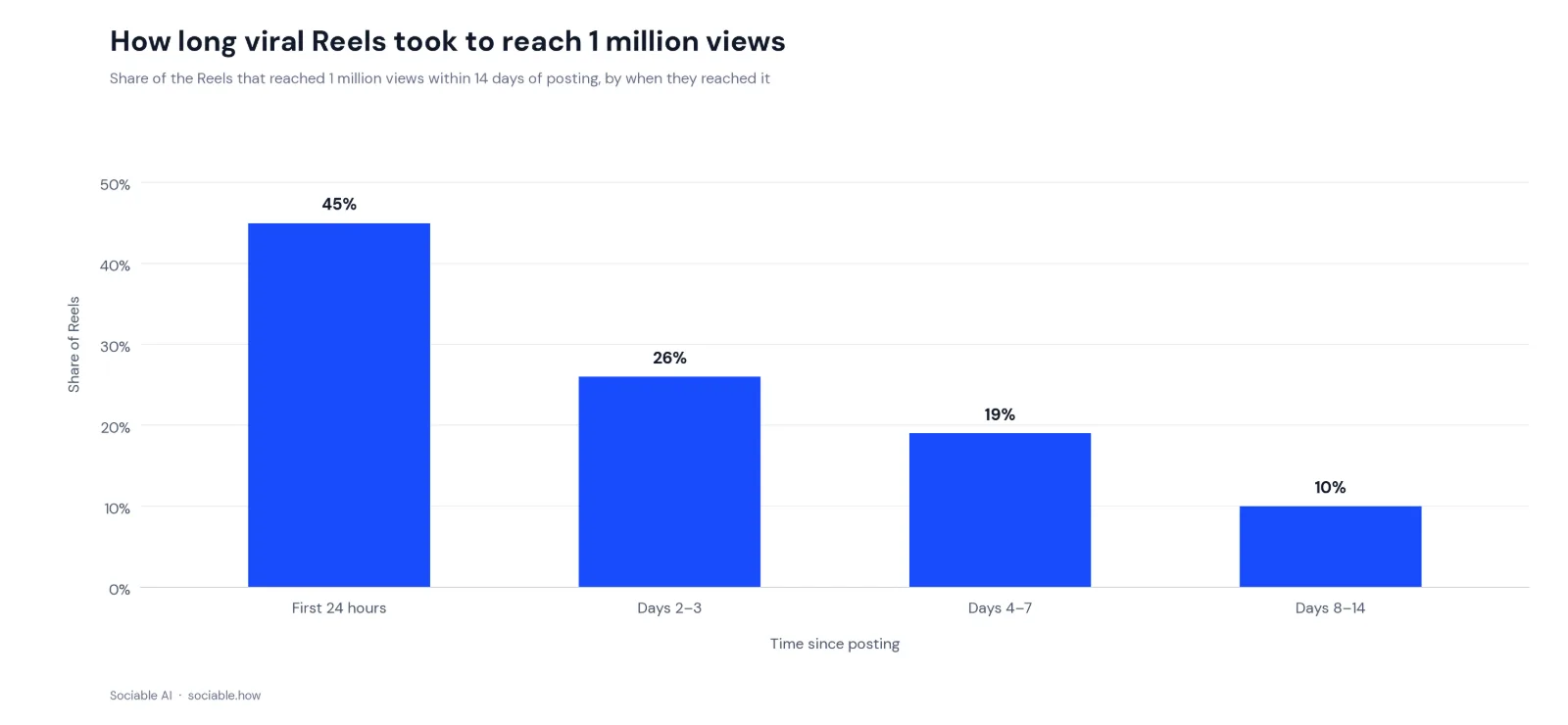
How long Reels that reached 1 million views took to get there, across the Reels we tracked for two weeks.
Viral Reels also had a lot of views from the first day. Reels that went on to reach 1 million views had a median of about 650,000 views 24 hours after posting. In other words, viral Reels rarely started small and slowly climbed their way up.
This also means a Reel's early view count can tell you when it's time to move on. Reels with fewer than about 250,000 views three days after posting almost never reached 1 million views. Out of the 437 Reels we tracked that were below 250,000 views on day 3, only 1 reached 1 million views within two weeks.
So give each video three days. If it's well below those numbers by then, leave it up and put your effort into your next video.
Get in early on videos that are going viral
Making your own video go viral is one way to reach new audiences. Another way is to show up early on someone else's video while it's going viral. When you comment on someone else's Reel, getting in early is what counts. In our data, comments left within the first hour of a Reel earned about three times as many likes as comments left a few hours later. Sociable AI users have earned nearly 1.4 million likes on comments left on other people's Reels.
Sociable AI monitors Reels across your niche as soon as they're posted and flags the ones that look like they're about to take off. We write a comment that fits the post, you approve it, and your comment goes live while the Reel is still climbing.
Try Sociable AI and get your next comment in early.
Frequently asked questions
How many views is considered viral?
One million views is the most common benchmark for how many views is considered viral, and 500,000 views is the most common benchmark for Instagram Reels specifically. If you'd rather measure against your own account, a video with ten times your normal views has gone viral for you.
What is the 3-second rule for videos?
The 3-second rule is the idea that a video has about three seconds to keep a viewer's attention. Instagram counts how many people watched at least three seconds of a Reel, as well as how often the Reel was skipped within two seconds of being opened. So those first few seconds decide whether a viewer counts toward your video's reach.
Can a video go viral days after posting?
Yes, but by then the video usually already has a lot of views. About half of the Reels that reached 1 million views got there after their first day. However, Reels with fewer than about 250,000 views on day 3 almost never made it to 1 million.