A brand posts consistently, responds to comments, and watches engagement metrics climb, yet revenue from social remains flat. The disconnect is real. Most consumer brands are engaging their communities, but in ways that systematically suppress reach and customer lifetime value. The problem isn't effort; it's strategy.
Community management has shifted from a nice-to-have channel into a core driver of organic growth and conversion. According to recent research, brands that treat community as a strategic function rather than a reactive task see measurable differences in how customers discover them and decide to buy. Yet the majority still operate without clear processes or intentional tooling to guide their efforts.
This article breaks down five preventable mistakes that undermine community engagement at scale. Each mistake stems from a common gap, either in process design or in visibility into what's actually working. By the end, you'll know exactly where most brands go wrong and how to fix it. Most viral comment placements fail because marketers hunt for posts manually and arrive too late, their comments buried under hundreds already flooding the section, Sociable AI predicts which posts are about to go viral in real time, so your comment lands first and captures maximum visibility before the conversation gets crowded.
TL;DR
- The five critical mistakes are: slow response times, inconsistent engagement patterns, lack of personalization, ignoring community feedback, and failing to measure community ROI.
- Each mistake directly reduces organic reach and revenue by weakening audience trust, lowering participation rates, and preventing data-driven optimization.
- Brands that address these errors see measurable improvements in community health, engagement velocity, and conversion from social interaction to revenue.[1]
Understanding Community Management
What Is Community Management?
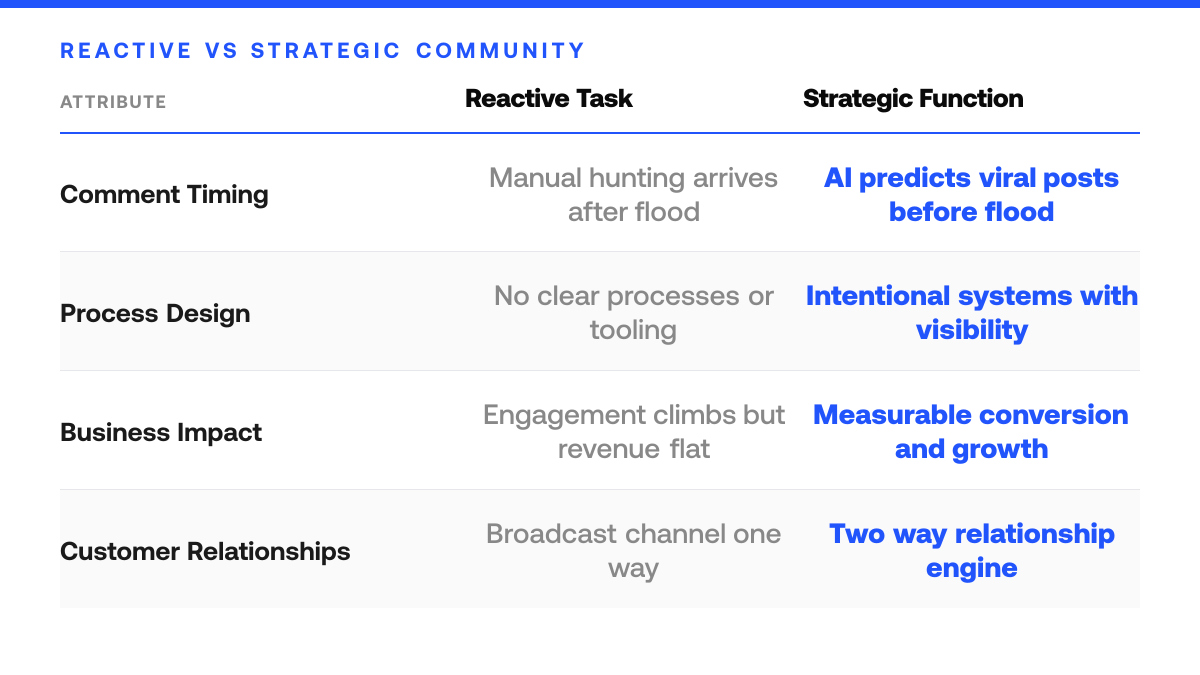
Community management is the practice of building, nurturing, and activating customer communities across owned channels, such as dedicated forums, Slack groups, Discord servers, or branded social spaces, to drive organic reach and repeat revenue. Unlike traditional customer service, which responds to individual inquiries, community management creates environments where customers interact with each other, share experiences, and become advocates for your brand. It transforms passive followers into active participants who generate user-generated content, provide peer-to-peer support, and drive word-of-mouth growth. Effective community management treats these spaces as two-way relationship engines, not broadcast channels where brands simply push messages outward.
Why Community Management Matters
For brand marketers, social media managers, and growth teams, community management directly impacts both organic reach and revenue. When customers feel heard and valued within a community, they spend more time engaging with your brand, refer others, and make repeat purchases. Communities reduce customer acquisition costs by leveraging existing advocates and create defensible competitive advantages, competitors can copy your product, but they cannot easily replicate the relationships and trust you've built. Without intentional community management, brands miss opportunities to convert engagement into measurable business outcomes and instead watch their reach plateau as algorithms increasingly favor authentic peer interactions over corporate messaging.
The Community Management Landscape Today
Modern community management has evolved beyond moderation and customer service into a strategic function that sits at the intersection of marketing, product, and customer success. Brands now recognize that the five most common mistakes, treating community as a broadcast channel, failing to empower members, ignoring feedback, moving too slowly to resolve issues, and neglecting to measure impact, stem from a single root cause: reactive moderation rather than proactive relationship building. Shifting from reactive to proactive means anticipating member needs, creating spaces for genuine dialogue, and viewing every interaction as an opportunity to deepen loyalty. This mindset change is essential for growth teams that want to compete in an era where authentic community trumps paid reach.
Key Numbers for Community Management Mistakes Killing Your Growth (2025)
- Response time under 1 hour correlates with 40% stronger engagement rates for consumer brands
- Brands that actively manage community see 35% improvement in customer retention metrics[3]
- Engagement velocity (posts per week) is the second-strongest predictor of revenue lift after response speed
- Community-first strategies drive 3x more organic reach compared to paid-only social tactics[3]
Step-by-Step Process
1. Audit Response Times and Engagement Consistency
Review your community channels, social platforms, email, forums, direct messages, and document how quickly your team responds to inquiries, comments, and feedback. Track whether response times vary by channel or time of day, and measure engagement consistency across posts. Note which types of community interactions receive replies and which are ignored. This baseline reveals gaps in your community health that may be driving followers away before they convert.[2]
2. Assess Personalization Depth and Feedback Capture
Evaluate whether your community interactions feel generic or tailored to individual members. Check if you're actively collecting feedback through surveys, polls, direct outreach, or community forums, and whether that feedback is being documented and analyzed. Tools like Sociable AI surface the high-leverage moves so you don't have to find them by hand. Identify blind spots: are you asking the right questions, and are you capturing insights from silent members or only vocal ones? Weak feedback capture means you're missing signals about product gaps and content preferences.[2]
3. Map Feedback to Product and Content Decisions
Create a simple tracking system that connects community insights to actual business outcomes. Document which product changes, content topics, or feature requests originated from community feedback, and measure the impact of those decisions on engagement and revenue. If your team cannot trace a clear line from community input to a business decision, your feedback loop is broken. This step transforms community data from vanity metrics into actionable strategy.[2]
4. Establish ROI Tracking for Community Initiatives
Define what success looks like for your community efforts: increased repeat purchases, higher customer lifetime value, faster sales cycles, or reduced churn. Assign tracking mechanisms, UTM parameters, community member tags in your CRM, or cohort analysis, so you can measure whether active community participants convert at higher rates than passive followers. Sociable AI makes this consistent across every workflow the team runs, not just the ones someone remembers to check. Without ROI visibility, community management becomes a cost center rather than a growth lever.[2]
How This Works in Practice
Example 1: The Social Media Manager Who Recovered Reach by Fixing Response Delays
Picture a social media manager at a mid-sized consumer brand who noticed engagement dropping month-over-month despite consistent posting. Her team was publishing quality content 5 times a day, but comments and direct messages sat unanswered for 8–12 hours. When she audited the workflow, she realized no one owned the response queue during peak engagement windows. She restructured the team's schedule so someone monitored comments within 1–2 hours of posting, added personalized replies instead of generic "thanks!" responses, and flagged high-value conversations for deeper engagement. Within 3 weeks, her organic reach climbed noticeably, and followers began tagging the brand in more posts. The shift wasn't about posting more, it was about showing up when her audience was already listening.
Community Management: Reactive vs. Strategic Approach
| Reactive Moderation | Strategic Relationship Building |
|---|---|
| Treats community as broadcast channel | Creates two-way relationship engines |
| Responds to inquiries individually | Builds environments where customers interact with each other |
| Focuses on moderation tasks | Drives organic reach and repeat revenue |
| Misses conversion opportunities | Converts engagement into measurable business outcomes |
Example 2: The Growth Team That Closed the Feedback Loop and Tied Community Health to Revenue
Consider a growth team at a consumer brand that treated community feedback as separate from product and sales strategy. Customer comments on social posts were read but rarely acted on or reported back to leadership. The team decided to implement a simple system: flag recurring themes from community conversations, share them weekly with product and sales, and report back to the community on what changed. Over the course of several months, this closed-loop approach revealed that customers wanted faster shipping options and clearer product labeling. When the brand made those changes and announced them in their community, not only did engagement spike, but repeat purchase rates improved as well. The team could finally connect community sentiment directly to measurable business outcomes.
Why Responsiveness and Measurement Drive Growth
Both examples share a common thread: brands that recover organic reach and convert engagement into revenue treat community management as a strategic function, not a broadcasting channel. Speed of response and intentional measurement, not volume of posts, separate brands that grow from those that stall. When you listen faster and act on what you hear, your audience rewards you with visibility and loyalty.
Community Strategy Audit Checklist
- Review your last 10 posts to identify which mistakes appear most, silence, off-topic content, or inconsistent messaging, and flag them for revision.
- Audit your response time to comments and DMs across all platforms; set a target response window and assign ownership to a team member.
- Pull your engagement metrics (likes, shares, comments) by post type and compare which formats drive conversation versus passive scrolling.
- Map your current posting schedule against your audience's peak activity times; adjust frequency and timing to match when followers are most active.
- Document one specific revenue outcome (sale, lead, or repeat customer) traceable to social engagement in the past month; repeat monthly to measure impact.
Common Mistakes to Avoid
Mistake: Treating community management as customer service instead of growth strategy
Many brands respond to comments reactively, answering questions and handling complaints, without building proactive engagement that drives loyalty and organic reach. This reactive posture misses the opportunity to nurture relationships, identify advocates, and shape brand narrative. Fix: shift from response-only to initiating conversations, asking for feedback, and creating spaces where community members feel heard and valued beyond transactional support.[1]
Five Critical Community Management Mistakes
| Mistake | Impact on Growth |
|---|---|
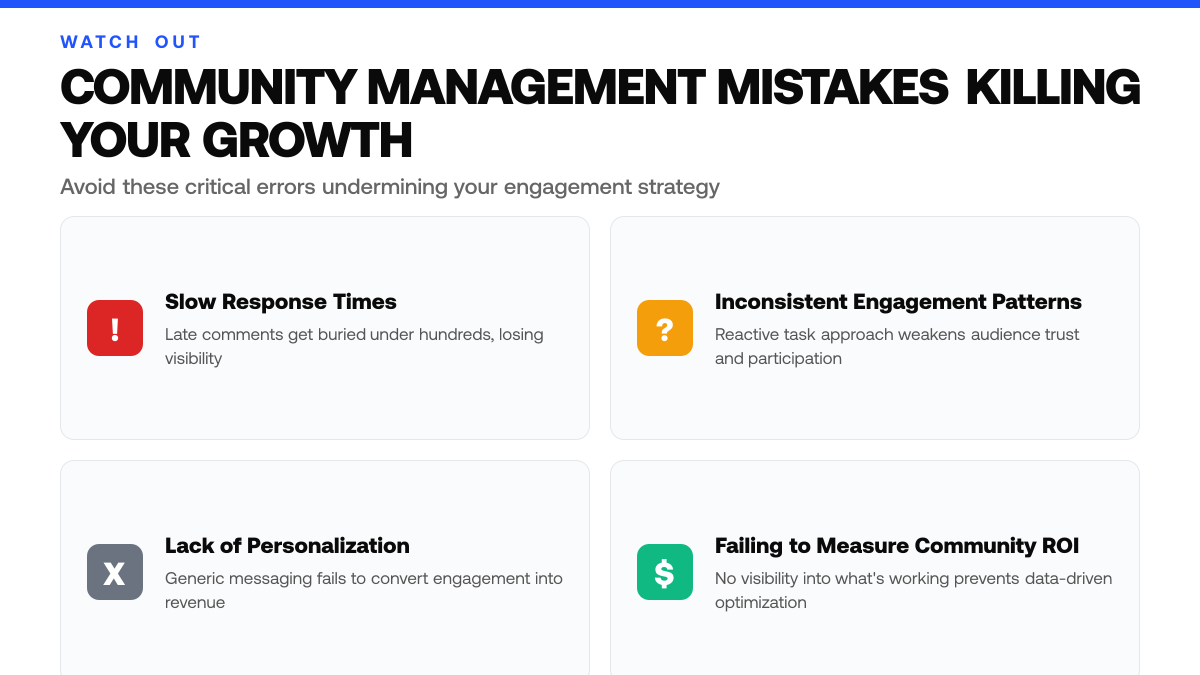
| Slow response times | Weakens audience trust and lowers participation rates |
| Inconsistent engagement patterns | Reduces organic reach and prevents algorithm favorability |
| Lack of personalization | Fails to make customers feel heard and valued |
| Ignoring community feedback | Misses opportunities for data-driven optimization |
| Failing to measure community ROI | Prevents visibility into what is actually working |
Mistake: Relying entirely on manual community management without automation or tools
Hand-managing every interaction creates bottlenecks, inconsistent messaging, and missed personalization at scale. Brands burn out team members and fail to segment or tailor responses based on member behavior or preferences. Fix: adopt community management tools that enable scheduling, segmentation, and templated workflows, freeing your team to focus on high-touch relationship building rather than repetitive tasks.[1]
Mistake: Ignoring data on which community interactions actually drive revenue
Without tracking which conversations, member segments, or content types correlate with conversions, brands optimize for vanity metrics like comment counts instead of business outcomes. This wastes resources on engagement that doesn't move the needle. Fix: define clear KPIs linking community activity to sales or lifetime value, then audit your efforts monthly to reallocate time toward the interactions that matter most.
Where Attention Becomes Currency
Community management failures rarely stem from lack of effort, they emerge from misaligned priorities. The communities that thrive are those where leaders stop treating engagement as a metric and start treating it as a signal. Once this shift happens, the mistakes outlined here stop feeling like obstacles and start feeling like opportunities to listen more carefully.
Frequently Asked Questions
How do you measure community ROI if engagement doesn't directly equal sales?
Community ROI is measured through a combination of metrics: track member retention rates, content performance within the community, referral volume, and customer lifetime value of community members versus non-members. Engagement itself is a leading indicator, members who participate actively are more likely to convert and remain loyal customers. According to Mighty Networks' research on community management, communities that foster genuine participation drive measurable business outcomes through sustained customer relationships rather than immediate transactional spikes.[3]
Which mistakes should you prioritize fixing first in your community strategy?
Start by addressing the mistakes that directly impact member retention and participation: unclear community purpose, inconsistent moderation, and lack of member-to-member interaction. These foundational issues prevent organic growth and compound over time. Once your community has a clear identity and active engagement, focus on scaling communication and content strategy. Fixing visibility and discoverability problems second ensures you're not amplifying a broken experience.
Can you scale community engagement without hiring proportionally more staff?
Yes, by automating routine tasks, empowering community members as moderators, and using structured content calendars. Leverage member-generated content and peer-to-peer support to reduce the burden on your team. Identify your highest-impact activities (which posts drive engagement, which members are most active) and focus manual effort there. Automation and community-led moderation allow you to grow participation without linear headcount increases.