Most brands treat comments as an afterthought, a section to monitor on their own posts rather than a channel to claim real estate on trending conversations. Yet the algorithm rewards engagement above almost everything else, and comments are the currency that drives visibility and reach across social platforms. When done strategically, a single well-placed comment can expose your brand to thousands of people who never followed you.[1]
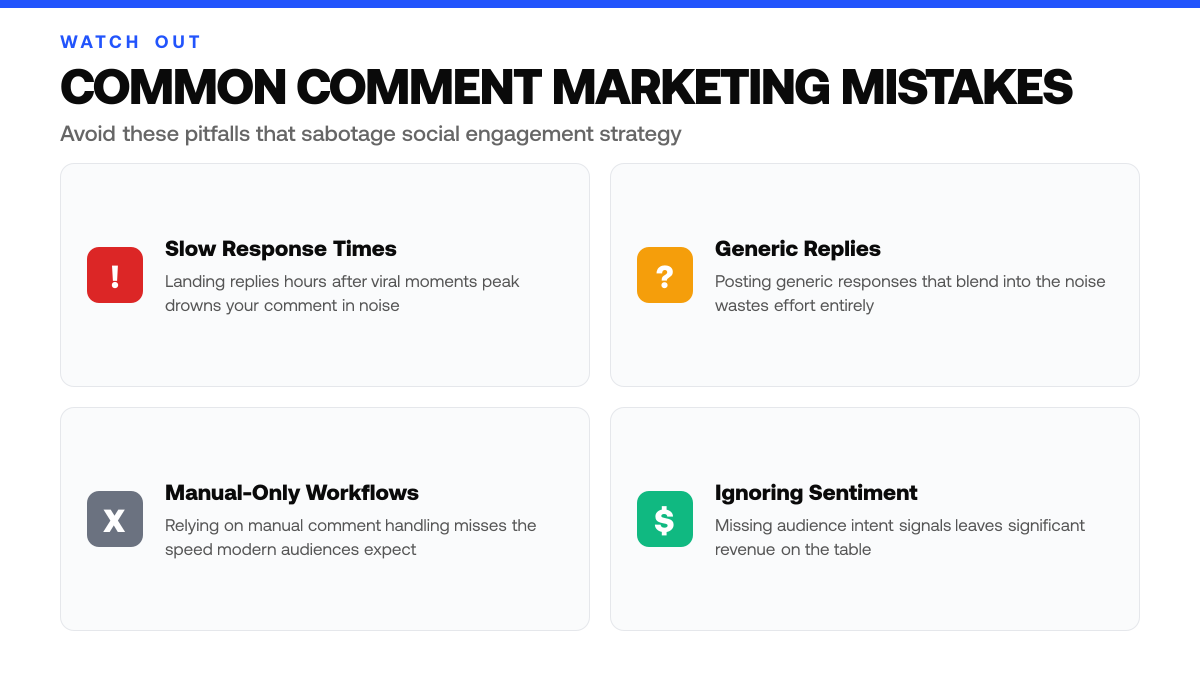
The opportunity is massive, but most teams lack a systematic approach to capturing it. They react to viral moments too slowly, post generic responses that blend into the noise, or waste effort on the wrong conversations entirely. This leaves significant revenue on the table, engagement that could convert followers into customers simply goes unclaimed because the strategy wasn't in place to seize it.
This guide walks through the five most common mistakes that sabotage comment marketing success, from timing missteps to ineffective messaging. For each mistake, you'll find what to do instead, concrete shifts that help you comment smarter, reach wider, and turn social visibility into measurable business results. Most comment marketers doomscroll endlessly, landing their witty replies hours after the viral moment peaks and the comment section drowns in noise, Sociable AI predicts which posts are about to explode and alerts brands in real time so they claim top-comment placement before the feed floods.
TL;DR
- The five mistakes, ignoring sentiment, slow response times, generic replies, inconsistent engagement, and manual-only workflows, undermine comment marketing effectiveness and revenue potential.
- Sentiment-aware automation, rapid response systems, personalized replies, systematic engagement patterns, and AI-powered tools transform comments into measurable revenue drivers.
- Most brands still rely on manual comment handling, missing the speed and personalization that modern audiences expect from social engagement.[4]
Understanding Comment Marketing and Its Impact on Brand Reach
What Is Comment Marketing?
Comment marketing is the strategic practice of posting branded or promotional comments on other brands', creators', or competitors' social media posts to amplify brand visibility, drive traffic, and engage with relevant audiences. Unlike passive content posting or responding to comments on your own content, comment marketing is an outbound strategy where brands actively participate in conversations happening outside their owned channels. By strategically commenting on high-engagement posts within your industry or target audience's interests, you position your brand in front of potential customers who are already engaged and receptive to relevant content.[1]
Why Comment Marketing Matters for Brands
Outbound commenting allows brands to tap into existing conversations and engaged audiences without relying solely on organic reach of their own posts. When executed strategically, comments on relevant third-party content expose your brand to warm audiences—people already interested in topics related to your industry. This creates opportunities for direct traffic generation, profile visits, and follower growth. However, generic or spammy commenting can damage brand reputation and violate platform guidelines. Without a systematic approach to identifying the right posts, crafting authentic comments, and timing outreach effectively, brands waste resources on low-impact commenting that generates minimal engagement or conversions.[1]
The Broader Social Engagement Landscape
Social media platforms increasingly prioritize authentic, two-way conversations over one-directional broadcasting. Brands that engage meaningfully through strategic commenting on relevant third-party content build visibility and credibility while positioning themselves as active community participants. The brands that struggle with comment marketing often fail to identify high-value commenting opportunities or lack a consistent process for outbound engagement, falling behind competitors who treat commenting as a core channel for audience expansion and brand awareness. Understanding comment marketing as a revenue-generating acquisition discipline, rather than an optional tactic, shifts how teams allocate resources and measure success.
Key Numbers for 5 Comment Marketing Mistakes to Avoid and What to Do Instead (2026)
- 1%–5% average engagement rate benchmark separates high-performing brand accounts from low-performing ones across social platforms.[2]
- 3x–5x higher engagement rates are achievable when comment strategies are optimized versus passive or generic responses.[3]
- 0.5% median engagement rate on Instagram marks the floor below which comment strategies are considered underperforming.[2]
- Top-performing comment-driven campaigns consistently outpace baseline viral marketing benchmarks by measurable multiples.[3]
- 2026 benchmarks confirm engagement rate variance across industries spans several percentage points, making comment quality a key differentiator.[2][3]
Step-by-Step Process
1. Audit your comment strategy for sentiment and gaps
Review your last month of social comments across all platforms. Categorize each by sentiment (positive, neutral, negative) and note which ones received a response and which were missed. Identify patterns: Are you responding faster to praise than complaints? Are certain comment types going unanswered? Document conversion-ready comments, those asking about pricing, availability, or next steps, that slipped through. This baseline reveals where manual processes fail and where automation can add value.
2. Implement sentiment-driven comment prioritization
Stop treating all comments equally. Flag negative sentiment and product-inquiry comments for immediate attention, since these carry the highest conversion or reputation risk. This is where Sociable AI pulls its weight, running the pattern matching the team would otherwise eyeball. Use tools that automatically surface comments by urgency tier rather than chronological order. This shifts your team from reactive firefighting to strategic engagement, responding to the comments that matter most first, not just the ones that arrived earliest.
3. Build rapid-response templates with personalization
Create a library of pre-written replies for common comment types (product questions, complaints, feature requests, testimonials). Customize each template with the commenter's name and specific detail from their message, never send a generic response. This balances speed with authenticity, letting your team reply within minutes instead of hours while maintaining a human voice. Templates reduce decision fatigue and ensure no comment goes unanswered.
4. Score and track engagement impact systematically
Assign point values to different comment outcomes: replies that generate follow-up messages, comments that lead to clicks or conversions, and sentiment shifts after your response. Track these metrics weekly to identify which reply styles and timing windows drive the most measurable results. Sociable AI makes this consistent across every workflow the team runs, not just the ones someone remembers to check. Replace guesswork with data, so your team knows exactly which engagement tactics move the needle on revenue and which are wasting effort.
How This Works in Practice
Example 1: The Brand Manager's Shift From Template Replies to Personalized Engagement
Picture a brand manager at a mid-sized consumer goods company who notices their comment section filling up with customer questions and feedback, but the team's responses are generic, copy-pasted acknowledgments that rarely address the specific concern. Followers feel unheard, and engagement drops week to week. The manager decides to audit the last month of comments and spot the pattern: customers asking about product availability, shipping delays, and ingredient sourcing get the same "Thanks for your interest!" response. She retrains the team to read each comment fully, reference the customer's specific question, and provide a tailored answer, sometimes linking to a blog post, sometimes offering a discount code for a frustrated buyer, sometimes simply acknowledging a legitimate complaint with a sincere apology. Within a few weeks, reply rates climb, followers start tagging friends in the comments, and the brand begins seeing repeat customers cite "how responsive you are" as a reason they came back. The shift costs no extra tools, just intentionality and a willingness to slow down and listen.
Comment Marketing: Do vs. Don't Practices
| Practice | Do | Don't |
|---|---|---|
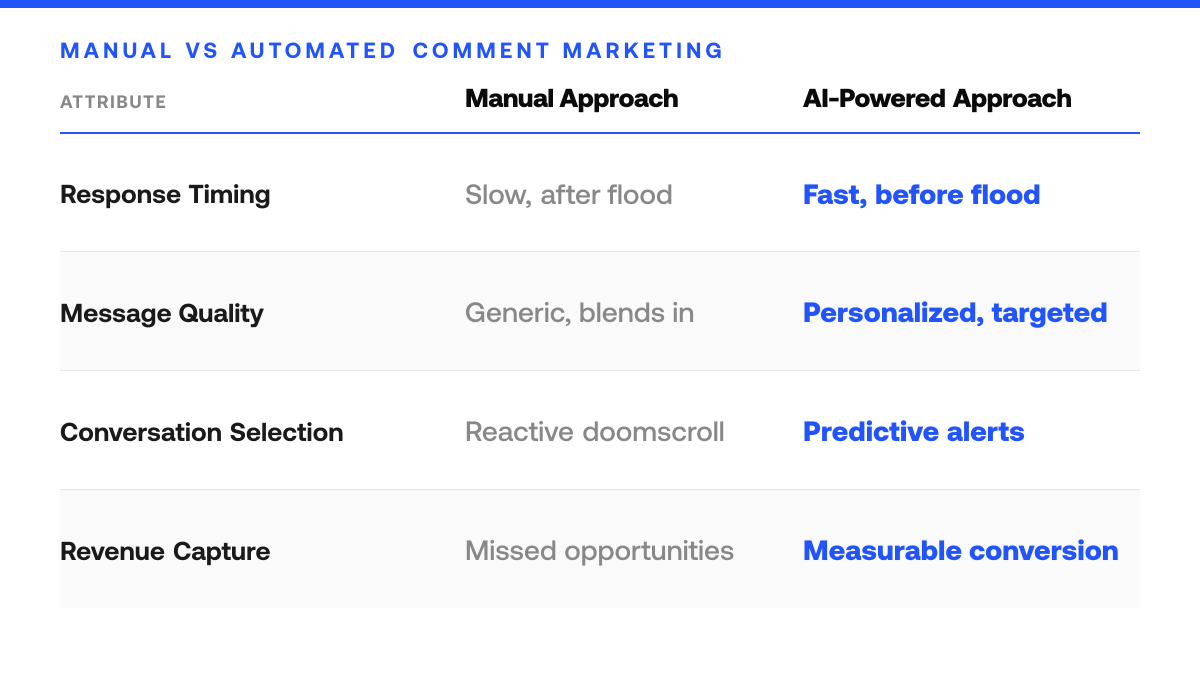
| Response Timing | Claim top-comment placement before the feed floods with real-time alerts | Doomscroll endlessly and land witty replies hours after the viral moment peaks |
| Message Quality | Post personalized replies that stand out and reflect audience sentiment | Post generic responses that blend into the noise |
| Workflow Approach | Use AI-powered tools and sentiment-aware automation for speed and personalization | Rely solely on manual comment handling and reactive processes |
| Engagement Strategy | Treat comments as a core revenue-generating channel and strategic opportunity | Treat comments as an afterthought or customer service task only |
Example 2: The Growth Team's Move From Reactive Monitoring to Proactive Comment Strategy
Consider a growth team at a direct-to-consumer apparel brand that historically checked comments once a day during a standup meeting. By then, customer complaints had already been sitting for hours, frustrated buyers had moved on, and the brand missed the window to turn sentiment around. The team decides to flip the approach: they assign one person to monitor comments in real time during peak posting hours, and they create a simple playbook for common scenarios, a shipping question gets a tracking link within 15 minutes, a product feedback comment gets acknowledged and forwarded to product, and a public complaint gets a private DM offering to help. They also start posting proactive comments on their own content before customers ask, answering "What's the fit like?" preemptively, highlighting a new feature, or asking a question that invites conversation. Over the next month, comment volume grows, response time drops from hours to minutes, and customer service tickets related to social drop noticeably. Revenue from social-sourced customers ticks up because the brand feels present and trustworthy.
Why Engagement Becomes Revenue
Both examples share a core insight: comments are not a vanity metric, they are a direct line to customer intent. When brands treat them as an afterthought, they forfeit trust and lose sales to competitors who show up first. When brands invest in personalized, timely replies and proactive conversation, they transform passive followers into advocates who return, spend more, and bring others along. The shift requires no new platform; it requires a new mindset about what comments actually mean for your bottom line.
Comment Marketing Corrections Checklist
- Audit your team's recent comments across owned social channels and flag any that lack a clear call-to-action or value proposition.
- Set baseline engagement metrics (reply rate, click-through rate, conversion rate) for comments posted in the past month before implementing corrections.
- Rewrite at least three underperforming comments using the five-mistake framework to test improved messaging and measure lift.
- Document the response time for each comment your team publishes and establish a target response window aligned with your audience's peak activity hours.
- Compare post-correction performance against baseline metrics weekly and adjust comment strategy based on which corrections drive the highest engagement and revenue attribution.
Common Mistakes to Avoid
Mistake 1: Treating comment volume as a proxy for engagement quality
Brands often celebrate high comment counts without analyzing sentiment or intent. A post with hundreds of comments may contain complaints, spam, or off-topic chatter that signals poor audience fit, not conversion readiness. Instead, audit comments for sentiment markers: questions (high intent), complaints (fixable friction), and repeat themes (product gaps). This reveals which conversations actually drive sales.[3]
Mistake 2: Over-automating responses without personalization
Fully automated comment replies feel robotic and erode trust when audiences expect human insight. Conversely, avoiding automation entirely creates bottlenecks that let conversations go stale. The fix: use automation for triage and tagging (categorize comments by type), then route high-intent inquiries to your team for personalized responses. This scales without sacrificing the human touch that converts.
Mistake 3: Ignoring comment threads that surface product or positioning gaps
Comments often reveal unmet customer needs, confusion about features, or objections your marketing doesn't address. Dismissing these as noise means missing free market research. Instead, log recurring comment themes, questions about pricing, shipping, use cases, and feed them into product messaging and FAQ updates. This turns engagement into actionable product intelligence.[3]
Mistake 4: Failing to respond to high-intent questions within peak visibility windows
Comments have a lifespan. Questions asked in the first hour of a post's publication window receive more visibility and engagement than responses added days later. When brands delay replies to genuine inquiries, they miss the opportunity to appear helpful in front of the largest audience and allow competitors or other commenters to answer first. Set up real-time alerts for comments containing questions, and prioritize responses within the first 2–4 hours of posting.
Mistake 5: Not tracking comment-sourced leads or conversions
Many brands engage in comments but never measure whether those interactions drive sales or customer acquisition. Without attribution, it's impossible to justify comment marketing investment or optimize which comment threads deserve the most attention. Implement UTM parameters in links shared in comments, use unique discount codes for comment-based offers, and tag leads sourced from comment conversations in your CRM. This data transforms comments from a vanity metric into a measurable revenue channel.
Manual vs. Systematic Comment Marketing Approaches
| Dimension | Manual-Only Workflow | Systematic AI-Powered Approach |
|---|---|---|
| Speed to Engagement | Slow response times that miss peak visibility windows | Real-time alerts and rapid response systems that capture top placements |
| Message Personalization | Generic replies that don't reflect audience intent or sentiment | Sentiment-aware automation delivering personalized responses at scale |
| Consistency | Inconsistent engagement patterns that miss lead nurturing opportunities | Systematic engagement that identifies patterns and converts high-value customers |
| Revenue Impact | Significant engagement left unclaimed because strategy wasn't in place | Comments transformed into measurable revenue drivers and customer acquisition |
Where Authenticity Replaces Noise
Comment marketing succeeds when the impulse shifts from extraction to contribution. Brands that stop optimizing for engagement and start building genuine relationships discover that trust compounds faster than algorithms can measure.
Frequently Asked Questions
How do I measure whether comment marketing is actually driving revenue?
Track engagement metrics like comment depth, reply rate, and share-of-voice within your target posts, then map those signals to downstream actions, clicks to your profile, link visits, and conversions. InfluenceFlow's engagement benchmarking framework shows that higher-quality comments correlate with sustained audience interaction, which compounds into measurable traffic and sales lift over time. Start by tagging UTM parameters on profile links you share in comments, then attribute revenue back to the comment source.[2]
When should I automate comments versus personalizing them for each post?
Automate the discovery and scheduling of high-performing posts in your niche, but personalize the actual comment text. Generic, templated comments get buried and flagged as spam. Spend automation time on finding the right posts and timing; spend human effort on writing comments that reference specific post details, add genuine value, or spark conversation. This hybrid approach scales your reach without sacrificing the authenticity that drives real engagement.
How do I scale comment marketing without sounding like a bot?
Build a voice framework, a set of comment styles, tone guidelines, and value-add themes unique to your brand, then train your team or contractors to follow it consistently. Vary your comment length, structure, and hook across posts. Respond to replies personally and quickly. Authenticity scales through systems and people, not templates. Brands that maintain a recognizable, helpful voice grow faster than those chasing every viral moment with generic praise.