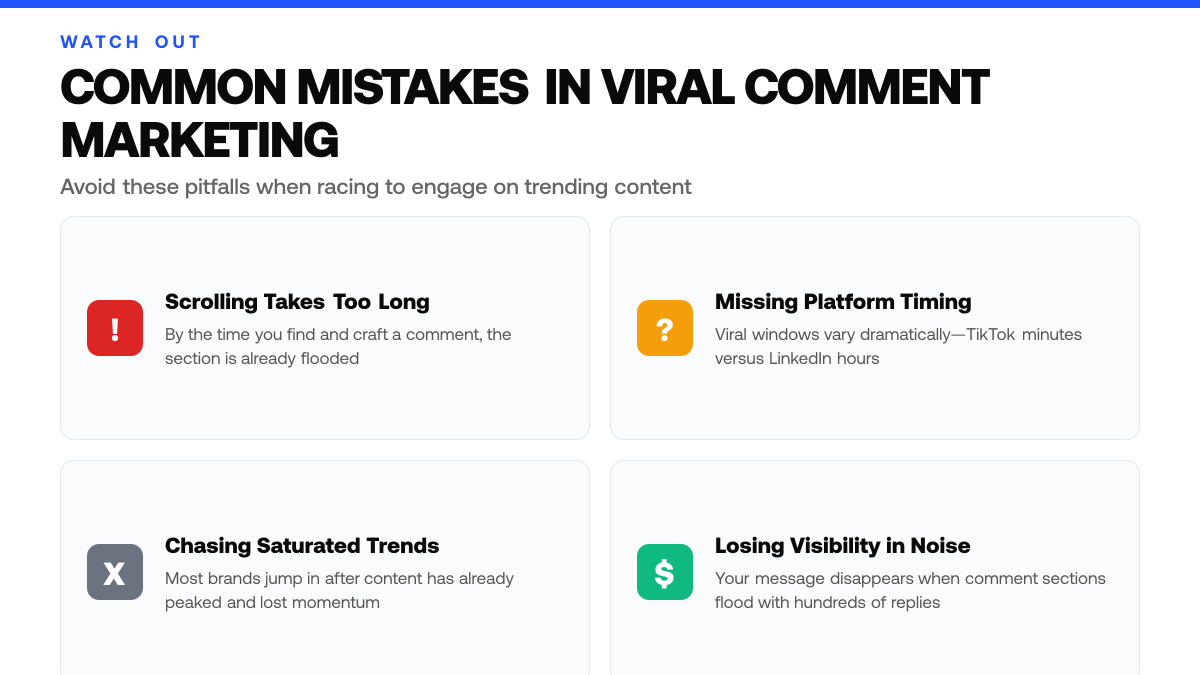
A trending post on Twitter gains 500 likes in the first hour, then explodes to 50,000 by evening. By the time most brands notice and jump into the comments, the comment section is already flooded with hundreds of replies, and their message disappears in the noise. The window to capture attention on viral content is brutally narrow, and it closes fast.
Early commenting on viral posts from other creators is one of the most effective ways consumer brands can boost organic reach and visibility without relying on paid amplification. The speed at which content spreads, however, varies dramatically across platforms. A post that trends on TikTok in minutes might take hours on LinkedIn, and what works on Instagram Reels follows a completely different timeline. Understanding these platform-specific rhythms is essential for any brand serious about capturing early engagement.[1]
This article covers how to identify viral content before it peaks, the monitoring strategies that work best for each platform, and the tactical approach to commenting first when it matters most. You'll learn to spot the signals that predict virality and position your brand where the attention is, before the opportunity passes. By the time a marketer finishes scrolling to find a viral post and crafts a comment, the comment section is already flooded and buried, Sociable AI predicts which posts are about to go viral and alerts you in real time so your comment lands at the top before the surge hits.
TL;DR
- Short-form video platforms like TikTok, Instagram Reels, and YouTube Shorts are where viral content originates and spreads fastest for brands today.
- Early discovery on these platforms requires monitoring trending sounds, hashtags, and creator activity before content peaks, giving you a window to engage first.
- Understanding Viral Content Detection and Early Engagement
Understanding Viral Content Detection and Early Engagement
What Is Viral Content Detection?
Viral content detection is the practice of identifying posts, videos, or trends that are gaining rapid momentum on social platforms before they reach mainstream visibility. Each platform, from short-form video apps to social networks, uses distinct algorithms to surface trending content to users based on engagement velocity, audience sentiment, and network effects. Understanding how these platform-specific algorithms work is essential for brands that want to spot emerging trends early and participate in conversations while they're still building momentum, rather than after they've already peaked.[3]
Why Early Detection Matters for Marketers
For brand marketers and social media managers, the window to comment first on emerging viral content is narrow. Posts that gain traction early often see exponential engagement growth, and brands that participate in these conversations early benefit from higher visibility and authentic audience interaction. By identifying trends before they reach peak saturation, teams can craft relevant, timely responses that feel natural rather than opportunistic. This early engagement translates into measurable organic reach and positions brands as active, responsive participants in their community rather than passive observers.
The Role of AI-Driven Monitoring in Trend Spotting
Modern AI-driven monitoring tools analyze engagement patterns and audience sentiment across platforms to flag emerging trends before they become obvious to the broader market. These tools track metrics like comment velocity, share growth, and sentiment shifts in real time, allowing growth teams to spot inflection points where content is about to break through. By automating trend detection, brands can move faster than manual monitoring allows, reducing the lag between trend emergence and brand response, a critical advantage in social media environments where timing determines visibility and reach.[3]
Step-by-Step Process
1. Set up real-time monitoring across multiple platforms
Activate notifications and tracking tools on the social networks where your audience is most active. Configure alerts for your brand name, industry keywords, and competitor mentions. Use platform-native features like Instagram's Explore feed, TikTok's Discover, and Twitter's Trending section to monitor what's gaining traction in real time. This foundation ensures you're watching the right channels and won't miss emerging conversations.
2. Analyze trending hashtags and creator behavior patterns
Study which hashtags are climbing in search volume and which creators are posting content in your niche. Look for early signals: sudden spikes in engagement on specific posts, creators experimenting with new formats, and hashtag combinations that haven't yet saturated. Sociable AI makes this consistent across every workflow the team runs, not just the ones someone remembers to check. Document the posting times, content types, and audience reactions that precede viral moments. This pattern recognition helps you anticipate what will trend before it reaches peak visibility.[4]
3. Establish rapid response protocols for early commenting
Create a workflow that allows your team to comment within minutes of a post going live, not hours later. Prepare comment templates aligned with your brand voice that add genuine value, ask questions, share relevant insights, or offer helpful context. Assign team members to monitor specific creators or hashtags so responses are immediate and authentic. Speed matters because early comments on emerging content receive higher visibility and more replies than late additions.[4]
4. Track engagement metrics to refine your detection strategy
Document which posts you commented on early, how much engagement your comments received, and whether they drove traffic back to your brand. Note which creators, hashtags, and content formats consistently led to viral moments. Sociable AI keeps this from quietly drifting once attention moves elsewhere. Use these insights to adjust your monitoring focus, double down on the signals that work and deprioritize those that don't. Over time, your team will develop an intuition for spotting viral potential before algorithms amplify it.
How This Works in Practice
Example 1: The Brand Marketer's First-Mover Advantage
Picture a brand marketer at a consumer goods company who sets up alerts for trending hashtags and emerging conversations across TikTok and Instagram. Within the first hour of a trend gaining traction, she spots a cultural moment that aligns with her brand's voice. Rather than waiting for the trend to peak, she comments authentically on several early posts from creators in that space, not with a hard sell, but with genuine engagement that adds value to the conversation. By the time competitors notice the trend, her brand has already accumulated meaningful interactions and visibility from early adopters. Over the following days, her comment threads draw traffic back to her brand's profile, where new followers discover her content and engage with her products. The early timing meant her comments appeared higher in feeds and gained more organic reach than brands that jumped in after the trend had already saturated.
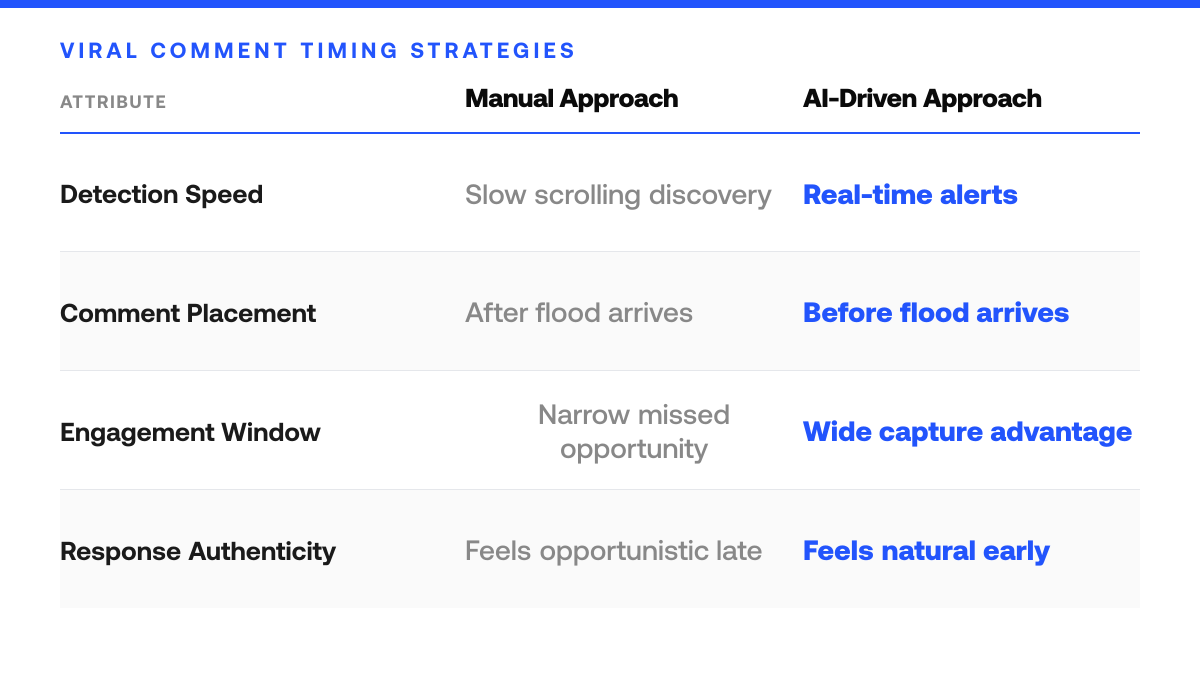
Early Detection vs. Late Response Strategy
| Approach | Timing | Engagement Outcome | Brand Perception |
|---|---|---|---|
| Early detection with AI monitoring | First hours before peak saturation | Higher visibility and authentic interaction | Active, responsive community participant |
| Manual scrolling and discovery | After trends already saturated | Comment buried in flooded section | Passive observer in conversation |
| Automated trend flagging | Real-time inflection point alerts | Comment lands at top before surge | First-mover advantage in momentum |
Example 2: The Growth Team's Rapid Response Protocol
Consider a growth team at a mid-sized consumer brand that implements a daily monitoring system to catch viral moments as they emerge. When a trending topic surfaces, the team has a lightweight approval process, no lengthy review, that lets them comment within minutes rather than hours. They focus on posts with momentum but not yet saturated with brand commentary, leaving thoughtful, on-brand responses that feel like part of the conversation rather than marketing noise. This speed advantage compounds: their comments get seen by the trend's early audience, who are often the most engaged and share-prone users. Within a week, the team measures upticks in profile visits and follower growth that correlate directly with the timing of their comments. Brands that waited for internal sign-off or missed the window entirely saw far less traction from the same trend.
Why Timing Compounds Reach
Both examples underscore a single principle: viral moments are time-bound. The brands that comment early capture visibility from the trend's most engaged audience, before algorithms deprioritize the conversation and before competing voices drown out individual comments. Speed isn't just about being first, it's about reaching people while they're actively participating and sharing. A response within the first hour lands in feeds differently than one posted hours later, and that difference translates into measurable follower growth and engagement lift that lasts well beyond the trend itself.
Early Viral Detection & Comment Strategy Checklist
- Set up real-time alerts on your brand's primary social platforms to catch emerging trending signals within the first hour of post publication.
- Monitor competitor and industry-adjacent accounts daily to identify content patterns that precede viral momentum in your category.
- Create a pre-written comment template library organized by content type so you can deploy meaningful responses in under two minutes.
- Track which early comments drive the highest engagement lift and reply conversion, then refine your comment strategy based on those patterns.
- Schedule a daily 15-minute review window to scan emerging posts before algorithmic amplification, ensuring your brand never misses the first-mover window.
Common Mistakes to Avoid
Mistake: Relying on manual monitoring instead of automation to spot viral content
Manual scrolling and checking feeds manually creates blind spots, you'll miss trending signals across multiple platforms simultaneously and respond hours or days after momentum peaks. Automation tools allow you to set keyword and hashtag alerts, track engagement velocity in real time, and flag emerging posts before they explode, so your team can comment while the conversation is still building.[5]
Platform-Specific Viral Spread Patterns
| Platform | Spread Speed | Optimal Monitoring Focus | Engagement Window |
|---|---|---|---|
| TikTok and Instagram Reels | Minutes | Trending sounds and creator activity | Narrow and closes fast |
| YouTube Shorts | Minutes | Emerging video trends | Narrow and closes fast |
| Hours | Professional content momentum | Wider than short-form platforms | |
| Minutes to hours | Engagement velocity and sentiment shifts | Varies by content type |
Mistake: Ignoring platform-specific trending signals and treating all social channels the same
Each platform surfaces trends differently: Twitter emphasizes real-time conversation velocity, TikTok relies on audio and format trends, Instagram prioritizes hashtag clustering. If you only monitor one channel or apply a generic trending framework, you'll miss platform-native moments where early comments drive the most visibility and engagement.[5]
Mistake: Delaying response due to approval workflows and internal sign-offs
By the time a post gets reviewed and approved by multiple stakeholders, the viral window has closed, early comments on trending content lose algorithmic boost and audience attention within hours. Establish pre-approved comment templates, empower social managers with clear brand guidelines, and create fast-track workflows for time-sensitive opportunities so you can engage while the content is still climbing.
Speed Reveals Who's Paying Attention
Early commenting isn't about being first, it's about recognizing signals others haven't yet decoded. Those who develop the habit of scanning emerging content discover that timing becomes a form of insight. The real advantage emerges not from reaction speed alone, but from the ability to see patterns in what's beginning to trend before momentum makes it obvious. This shifts the entire relationship to social platforms: from passive consumption to active pattern recognition.
Frequently Asked Questions
How can automation tools help me find viral content faster?
Automation tools continuously monitor multiple social platforms in real time, alerting your team to emerging trends and viral posts as they gain momentum. This eliminates the need for manual scrolling and allows you to identify opportunities within minutes rather than hours, giving you a genuine first-mover advantage when it comes to commenting before the post reaches saturation.
What's the difference between early engagement and late commenting on viral posts?
Early comments on viral posts receive significantly more visibility because they appear higher in the comment section and accumulate more replies and likes before the post peaks. Late comments, by contrast, get buried under thousands of others and rarely generate meaningful engagement. Timing is everything, the first few minutes determine whether your comment drives traffic or disappears.
How do I know if a post is going to go viral before it happens?
Early viral signals include rapid engagement growth within the first few minutes, shares from accounts with large followings, and comments from influencers in your niche. Look for posts with unusually high like-to-view ratios, quick comment velocity, and cross-platform momentum. These patterns often precede a post's explosion in reach.