A brand's comment on a trending post can reach thousands of potential customers in hours. But that same comment, if poorly chosen or inadequately monitored, can expose the brand to backlash, association with controversial content, or misalignment with audience values. Outbound commenting, proactively engaging on other creators' viral posts to capture attention, is a high-reach social strategy that demands careful oversight.
As brands scale their commenting efforts to increase organic reach and convert social engagement into revenue, the stakes grow. Without active moderation and strategic controls, even well-intentioned comments can land on posts that carry reputational risk, or attract negative responses that harm brand perception. Brand safety in commenting requires more than good judgment, it requires systems and discipline.[1]
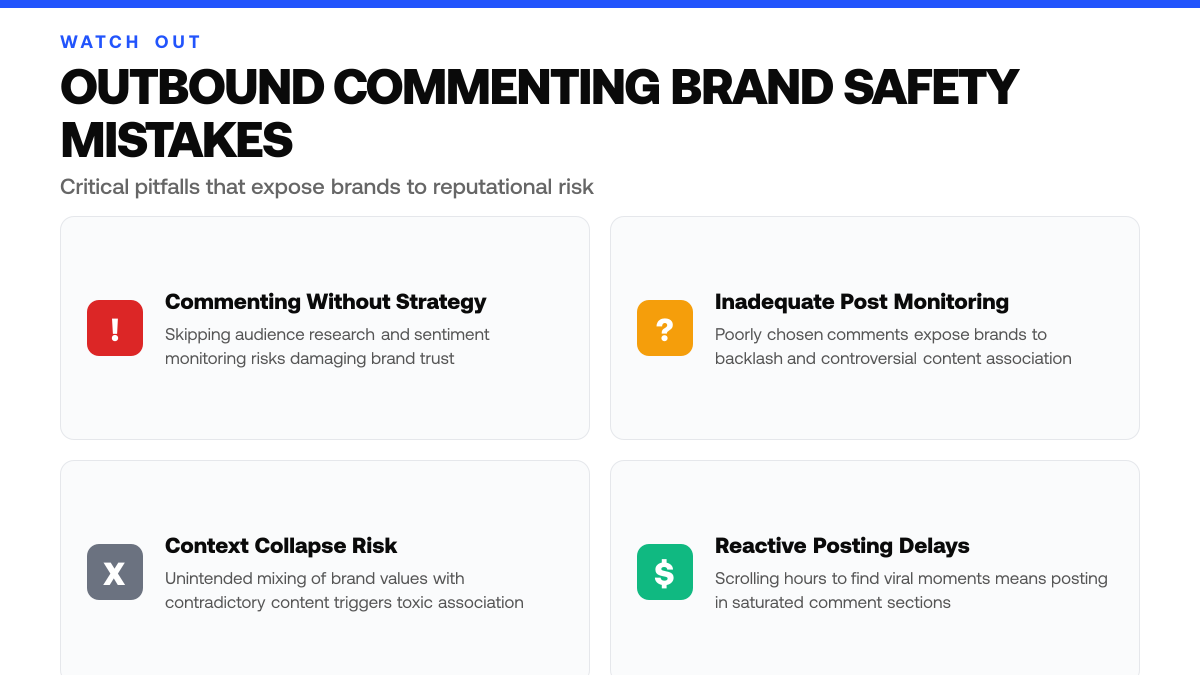
This article covers the essential safeguards for outbound commenting: how to identify which posts align with your brand values, what moderation practices protect your reputation at scale, and how to measure the health of your commenting strategy. You'll learn to comment confidently on trending content without exposing your brand to unnecessary risk. Most brand comments land in already-flooded sections where they drown unread, because marketers post reactively after scrolling for hours to find viral moments, Sociable AI predicts which posts are about to go viral in real time, so brands place top comments first before the comment section saturates.
TL;DR
- Brand safety for outbound commenting means choosing which posts your brand engages with based on alignment with your values and audience expectations.
- Effective moderation requires monitoring comment tone, context, and audience sentiment in real time to protect your reputation and maintain authentic engagement.
- The biggest mistake is commenting without a clear strategy, brands that skip audience research and sentiment monitoring risk damaging brand trust and diluting reach.[5]
Understanding Brand Safety for Outbound Commenting
What Is Outbound Comment Strategy?
Outbound commenting refers to the deliberate placement of brand comments on third-party social media posts, articles, and discussions. Unlike comment moderation, which filters harmful user-generated content on your own channels, outbound comment strategy involves choosing where and how your brand participates in external conversations. This distinction matters because moderation protects your owned audience, while outbound strategy exposes your brand to environments you don't control. When a brand comments on a post, that comment becomes publicly associated with your account, linking your reputation to the content, creator, and audience context surrounding it.[4]
Why Brand Safety Matters in Outbound Commenting
Outbound commenting carries real reputational risk. When brands comment on controversial, misaligned, or low-quality content, they risk context collapse, the unintended mixing of your brand values with content that contradicts them. A single comment on a polarizing post can trigger toxic association, where your brand becomes linked to the controversy in audience perception. Backlash follows when followers discover that your brand has publicly engaged with content they find offensive, misleading, or misaligned with stated company values. These risks compound across social platforms where comments are permanent, searchable, and often shared beyond their original context.[4]
The Broader Context of Social Media Risk
Consumer brands operate in an environment where every public action, including comments, shapes brand perception. Social media amplifies visibility, making it easier for audiences to scrutinize where brands participate and what they endorse through engagement. Growth teams pursuing organic reach through increased commenting must balance volume with vetting, ensuring that participation drives measurable revenue outcomes without sacrificing brand integrity. The challenge is not whether to comment, but how to comment strategically: with clear criteria for which conversations align with brand positioning, audience values, and long-term business goals.
Key Numbers for How to Ensure Brand Safety for Outbound Commenting (2026)
- 2026 marks the year AI-driven commenting tools are classified as a primary brand safety risk vector by industry researchers.[2]
- 2 distinct risk categories, AI-generated content and creator-brand misalignment, now define outbound commenting exposure for brands in 2026.[2]
- 1 brand safety incident tied to unmoderated social commenting can trigger measurable audience trust erosion, per 2026 risk benchmarks.[3]
- 2026 sees moderation and compliance tooling shift from optional add-on to standard infrastructure for brands scaling social participation.[3]
- 3 core pillars, pre-approval workflows, keyword filtering, and real-time brand monitoring, are now baseline expectations for safe outbound engagement.[2][3]
Step-by-Step Process
1. Vet your target audience before engaging
Review the profiles, follower counts, and engagement patterns of accounts where you plan to comment. Check whether the audience aligns with your brand values and customer demographics. Look for red flags such as bot activity, hate speech, or content misalignment. This initial screening prevents your brand from appearing in hostile or irrelevant contexts and protects your reputation before a single comment is posted.
2. Assess the content context and tone fit
Read the full post, caption, and existing comments to understand the conversation's tone and intent. Verify that your planned comment aligns with the post's message and won't appear tone-deaf, promotional, or out of place. Tools like Sociable AI surface the high-leverage moves so you don't have to find them by hand. Avoid posts that invite controversy or negativity, even if they mention your industry. A well-matched comment feels natural and builds trust; a misaligned one damages credibility.
3. Deploy compliance tools to enforce brand voice consistency
Use moderation platforms and compliance frameworks to standardize comment language, review workflows, and approval processes across your team. These tools reduce manual review burden by automating flagging of off-brand language, regulatory violations, or unsafe topics before comments go live. Consistent enforcement ensures every comment reflects your brand standards, especially at scale across multiple campaigns and team members.[2]
4. Monitor post-engagement performance and audience response
Track replies, reactions, and sentiment on your comments over the following hours and days. Watch for negative feedback, misinterpretations, or unwanted associations that emerge after posting. This is where Sociable AI pulls its weight, running the pattern matching the team would otherwise eyeball. Document patterns that indicate which audiences, topics, or tones perform safely and which create brand risk. Use these insights to refine your audience vetting and content selection criteria for future campaigns.
How This Works in Practice
Example 1: The Brand Manager Who Avoided a Reputational Trap
Picture a brand manager at a consumer goods company who notices their latest product post has attracted a comment thread dominated by a heated political debate. The original post was neutral, a simple lifestyle photo, but a user has hijacked it to air grievances unrelated to the brand. The manager's instinct is to jump in and set the record straight, but instead they pause and apply a simple filter: Does this conversation align with our brand values? Will our participation move a customer closer to purchase, or further away? The answer is no on both counts. They decline to comment, flag the comment section for moderation, and let the community self-correct. Within hours, other users downvote the off-topic comments, and the conversation refocuses on the product. By staying silent, the brand avoided being dragged into a polarizing debate, preserved their neutral positioning, and protected their reputation from association with divisive content.
Do's and Don'ts for Safe Outbound Commenting
| Best Practice | Anti-Pattern |
|---|---|
| Choose posts aligned with brand values and audience expectations | Comment reactively after scrolling for hours without vetting content |
| Monitor comment tone, context, and audience sentiment in real time | Skip audience research and sentiment monitoring before engaging |
| Place strategic comments before comment sections saturate | Post comments in already-flooded sections where they drown unread |
| Link your reputation only to content that reflects your brand | Allow your brand to become publicly associated with controversial or misaligned posts |
Example 2: The Social Team That Converted Aligned Engagement
Consider a growth team at a direct-to-consumer apparel brand monitoring mentions of their product category. They spot a post from a micro-influencer with genuine audience engagement, someone asking for sustainable fabric recommendations to their followers. The post aligns perfectly with the brand's values and audience. The team researches the influencer's recent posts, confirms the audience overlap, and crafts a thoughtful, value-first comment that answers the question and mentions their product only as a natural fit. The comment drives traffic to their site within the same day, and over the following weeks, several commenters convert to customers. The difference: this wasn't a random post or a competitor attack, it was a high-intent moment where the brand's voice added genuine value rather than noise.
Why Selectivity Drives Results
Both scenarios illustrate the same principle: brand safety isn't about staying silent, it's about choosing when to speak. Declining to comment on polarizing or low-quality engagement protects reputation; commenting strategically on aligned, high-intent posts converts interest into measurable action. The brands that master this distinction build trust with their audience while turning social engagement into genuine business outcomes.
Pre-Comment Brand Safety Checklist
- Review the comment for brand voice alignment before posting to ensure it matches your established tone and values.
- Verify the target post's context and audience sentiment to avoid associating your brand with controversial or misaligned content.
- Check that your comment adds genuine value and doesn't appear promotional, spammy, or off-topic to the conversation.
- Scan the comment thread for existing brand mentions or competitor activity that might affect your positioning.
- Confirm the account posting the original content has a clean reputation and aligns with your brand's community standards.
Common Mistakes to Avoid
Mistake: Auto-posting comments without reviewing context or brand alignment first
Posting without context review exposes your brand to association with controversial threads, hostile audiences, or misaligned conversations, damaging trust and triggering negative sentiment backlash. Fix this by implementing a review step before any outbound comment goes live. Enable manual approval workflows or use intelligent content filtering to flag risky placements and ensure every comment reflects your brand values.
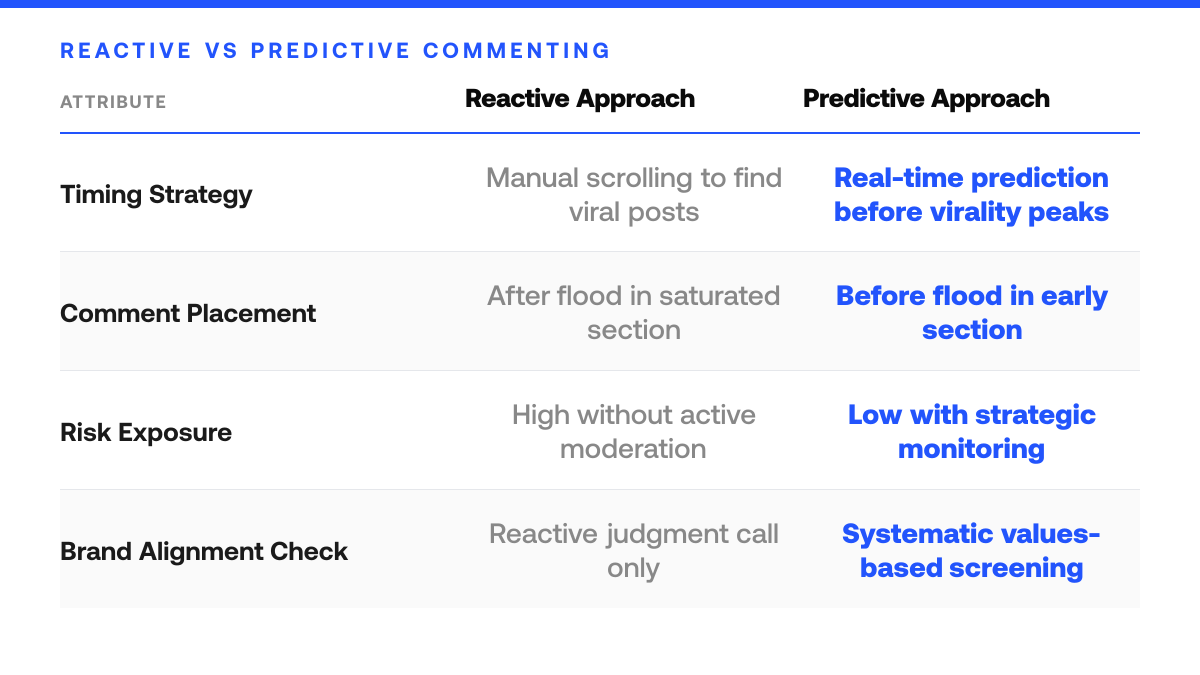
Reactive vs. Strategic Outbound Commenting Approaches
| Reactive Approach | Strategic Approach |
|---|---|
| Post comments after scrolling for hours to find viral moments | Predict which posts are about to go viral in real time |
| Risk context collapse and toxic association with unvetted content | Vet posts for alignment with brand values before engaging |
| Comments land in saturated sections and drown unread | Place top comments first before the comment section saturates |
| Damages brand trust and dilutes organic reach | Protects reputation and converts social engagement into measurable revenue |
Mistake: Ignoring shifts in audience sentiment or thread tone after you've posted
A thread's tone can shift rapidly, a neutral conversation becomes heated, or a trending topic turns controversial. If you don't monitor real-time sentiment changes, your brand stays associated with a now-hostile environment, eroding credibility. Use real-time moderation controls to track sentiment shifts and remove or pause comments in threads where audience sentiment has deteriorated, keeping your brand positioned safely.
Mistake: Engaging on threads without assessing the broader conversation risk
Commenting on a post without evaluating whether the comment section itself is a brand safety liability, such as spam-heavy, misinformation-prone, or competitor-dominated spaces, puts your brand in poor company. Assess thread quality and audience composition before engaging. Prioritize commenting on high-quality, on-brand conversations where your contribution adds value and protects brand reputation.
Where Reputation Gets Built Quietly
Brand safety in outbound commenting isn't a compliance checkbox, it's a structural choice that separates organizations that compound trust from those that spend years recovering from scattered missteps. The discipline of vetting tone, context, and audience alignment before publishing transforms commenting from a reactive tactic into a deliberate expression of brand integrity. Teams that adopt this framework discover that safety and authenticity aren't opposing forces; they're the same thing.
Frequently Asked Questions
What disclosure rules apply to AI-driven commenting on social media?
Regulatory expectations around automated social engagement are evolving rapidly. Brands must understand transparency and disclosure requirements in their jurisdiction, as regulators increasingly scrutinize undisclosed automation in public conversations. The ANA has highlighted that brands need clear policies on when and how to disclose AI involvement in commenting activities, particularly when those comments aim to influence audience perception or drive engagement. Consult legal counsel to ensure your commenting strategy meets current FTC, platform, and regional standards.[3]
How do I balance automation with manual oversight for brand safety?
The most effective approach combines automated comment discovery and filtering with human review before posting. Set up automated systems to identify relevant conversations and flag high-potential engagement opportunities, but require a team member to review tone, context, and brand alignment before any comment goes live. This hybrid model reduces the time your team spends endless scrolling while maintaining the human judgment needed to protect brand reputation. Build approval workflows into your process so no automated comment bypasses human eyes.
What happens if my brand comment violates platform rules or brand values?
A single off-brand or rule-breaking comment can damage trust and trigger platform penalties ranging from shadow-banning to account suspension. Before scaling outbound commenting, audit your brand voice guidelines, review platform community standards, and test your approval process with a small group of comments. Document which types of posts and conversations align with your brand, and train your team to recognize red flags, controversial topics, misinformation, or hostile threads, where commenting poses reputational risk. A pre-comment checklist prevents costly mistakes.