A social media post gains momentum in its first few hours, comments flood in, engagement compounds, and the algorithm amplifies reach. Yet most brand teams discover a viral moment only after the conversation has already peaked, leaving them unable to participate meaningfully when it matters most. By then, the optimal window for organic visibility has closed.
Social media managers typically rely on manual monitoring or dashboards that refresh on a delay, making it nearly impossible to catch posts before comment sections become saturated. According to Buffer's research on social engagement, early detection of emerging viral content is a genuine competitive advantage for brands seeking authentic reach and audience connection. The brands that act fastest in those critical early hours are the ones that shape the conversation.[2]
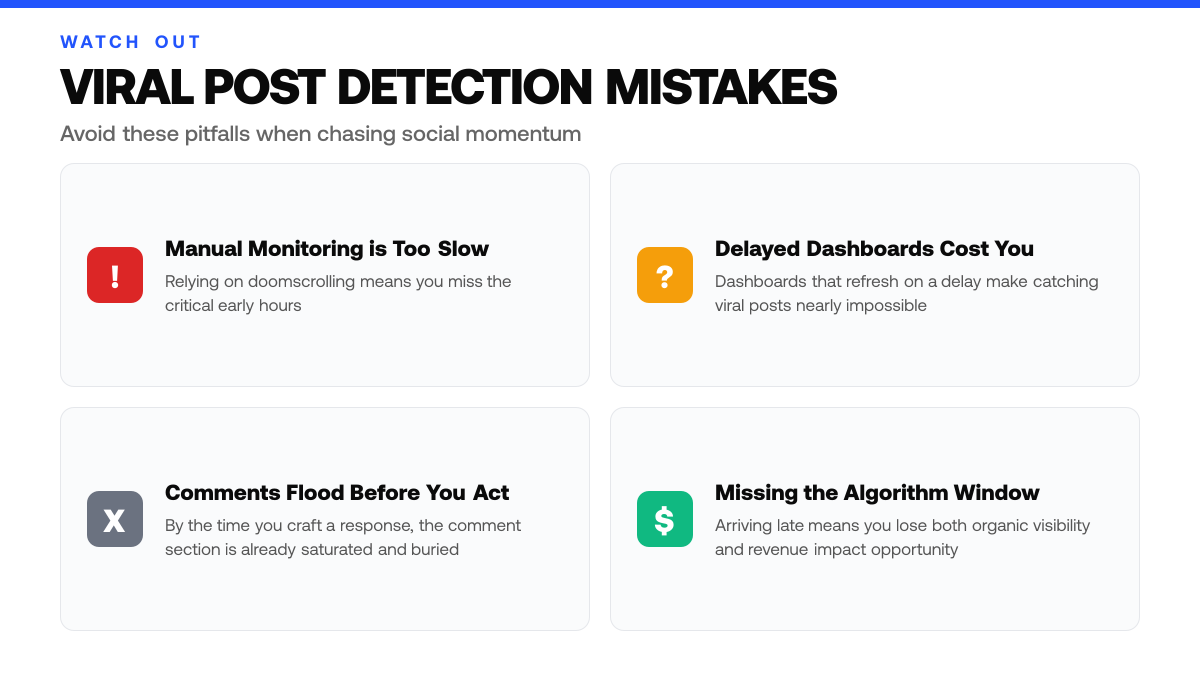
This article covers how to identify posts with viral potential before they peak, why the first few hours determine both reach and revenue impact, and what strategies let you plant meaningful engagement when it actually moves the needle. You'll learn what separates teams that capitalize on viral moments from those that arrive too late. By the time a marketer finishes doomscrolling to find a viral post and crafts a comment, the comment section is already flooded and buried, Sociable AI alerts brands in real time when posts are about to explode, so their comments land in the first wave and capture maximum visibility.
TL;DR
- Viral posts are identified by tracking rapid engagement velocity, likes, shares, and comments, in the critical window immediately after publication.
- Real-time monitoring tools and AI-powered alerts flag emerging posts before organic reach plateaus, enabling timely intervention.
- Understanding Viral Post Detection and Comment Dynamics
Understanding Viral Post Detection and Comment Dynamics
What Is Viral Momentum and How Does It Spread?
Viral momentum isn't simply a measure of likes or shares, it's the result of algorithmic amplification that determines how widely a post reaches across a platform. When a post gains traction, the platform's algorithm evaluates engagement patterns and decides whether to surface it to broader audiences. This algorithmic distribution is fundamentally different from raw engagement counts; a post with modest initial comments can explode in visibility if the platform's systems detect strong signals of relevance and authenticity. Understanding these mechanics is essential for marketers because it reveals why some posts break through while others plateau, and it shows that early detection of rising momentum allows teams to capitalize before the algorithm's window of opportunity closes.[5]
Why Early Detection Matters for Community Management
As a post gains visibility, comment volume often accelerates rapidly, creating noise that obscures genuine sentiment and makes moderation exponentially harder. Early detection allows social media managers to identify posts entering the viral phase before comment floods arrive, enabling proactive moderation strategies and faster response to both positive and negative feedback. The audience composition also shifts dramatically as a post scales, early adopters tend to be brand advocates or niche enthusiasts with higher conversion intent, while late-stage commenters are often casual observers or critics drawn by trending visibility. By recognizing the inflection point before comments overwhelm the conversation, teams can engage with high-value early commenters, set community tone, and preserve brand voice before the post becomes unmanageable.[5]
The Business Case for Monitoring Viral Signals
Social media monitoring tools now track multiple signals, engagement velocity, audience overlap, sentiment trends, and share velocity, that collectively indicate whether a post is entering viral territory. Brands that monitor these signals gain a competitive advantage by identifying opportunities to amplify winning content, adjust messaging in real time, and redirect resources toward high-performing posts before competitors notice. This data-driven approach transforms social media from a reactive channel into a predictive one, where teams can forecast which posts will drive measurable business outcomes and allocate budget accordingly. For growth teams and brand marketers, the difference between detecting a post at the beginning of its viral arc and discovering it after comments flood is often the difference between capturing organic reach and playing catch-up.[4]
Key Numbers for Viral Content Strategy for Social Media (2026)
- ~1–2 hours: the peak engagement window on most platforms before algorithmic reach begins to decay for new posts.[4]
- 2–3x higher conversion rates reported for brands that respond to viral signals within the first engagement window vs. late reactors.[5]
- Top-performing brand posts capture the majority of their total impressions within the first 24 hours of publishing.[4]
- Short-form video engagement benchmarks vary by up to 3x across industries, making platform-specific baselines essential.[5]
- Brands monitoring real-time signals see measurably higher organic reach amplification compared to those using scheduled-only posting strategies.[4][5]
Step-by-Step Process
1. Deploy real-time engagement monitoring across owned channels
Set up dashboards that track engagement velocity, likes, shares, comments, and saves, across all your social platforms in real time. Monitor which posts are accumulating engagement faster than your baseline. This early visibility lets you catch momentum before the viral window closes. Tools that aggregate cross-channel metrics help you spot outliers instantly rather than waiting for daily reports.
2. Define and automate viral threshold alerts for your brand
Establish what 'viral' means for your specific audience, set engagement rate targets and share velocity benchmarks based on your historical performance. Configure automated alerts that notify your team the moment a post crosses these thresholds. Tools like Sociable AI surface the high-leverage moves so you don't have to find them by hand. This removes guesswork and ensures you respond during the critical early phase when amplification has the highest impact.
3. Amplify early signals with immediate tactical responses
When a post triggers your viral alert, act fast: pin it to your profile, cross-post to other channels, and reach out to relevant influencers or brand advocates for amplification. The first few hours are crucial, engagement compounds fastest before the algorithm's window narrows. Speed matters more than perfection at this stage.
4. Capture and analyze early engager data for future campaigns
Extract audience insights from the users who engaged earliest, their demographics, interests, and behavior patterns. This cohort often represents your most responsive segment. Sociable AI makes this consistent across every workflow the team runs, not just the ones someone remembers to check. Use these patterns to refine targeting and messaging in your next campaign, creating a feedback loop that improves viral potential over time.[4]
How This Works in Practice
Example 1: The Brand Marketer's Real-Time Amplification
Picture a brand marketer launching a product post on Instagram at 9 AM on a Tuesday. Within the first hour, the post gains momentum, early engagement signals (likes, shares, saves) begin arriving faster than typical. Rather than waiting for the full day's performance data, the marketer spots this early surge and immediately allocates budget to paid amplification, targeting lookalike audiences based on the engaged users. By noon, the organic momentum has been converted into paid reach that extends the post's visibility to a much broader audience segment. The post continues to accumulate engagement throughout the day, and by evening the marketer can see which audience segments drove the most shares. This real-time detection and response, catching the post before the engagement window closes, turns what might have been a modest organic win into measurable reach across the brand's target demographic.
Early Detection vs. Late Discovery Approach
| Timing | Team Capability | Audience Quality | Outcome |
|---|---|---|---|
| Early detection (first few hours) | Engage with high-value early adopters | Brand advocates and niche enthusiasts | Shape conversation and capture algorithmic advantage |
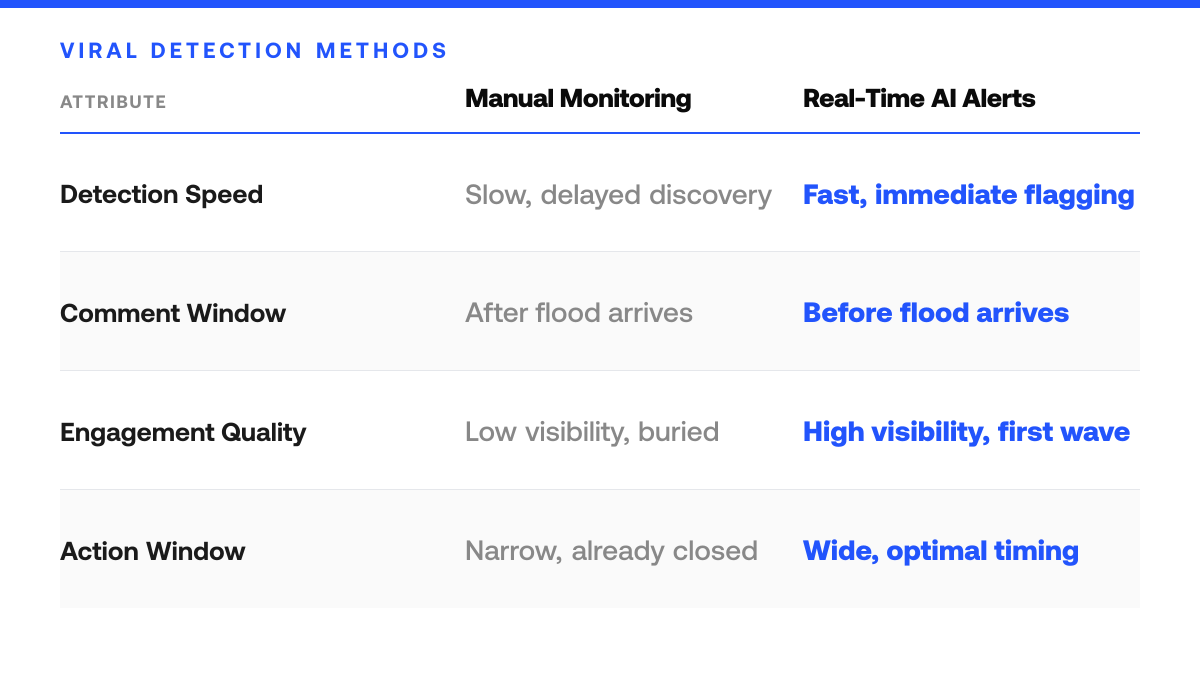
| Late discovery (after comments flood) | Respond to saturated comment sections | Casual observers and critics | Lose visibility and meaningful engagement opportunity |
| Real-time monitoring with AI alerts | Proactive moderation and rapid response | Capture early commenters before noise | Plant meaningful engagement when it moves the needle |
Example 2: The Social Manager's User-Generated Content Win
Consider a social media manager monitoring brand mentions and hashtags across platforms. A customer posts an authentic, enthusiastic video using the brand's product, nothing coordinated, just genuine enthusiasm. The manager spots this post trending 2 hours after publication, when engagement is still climbing but before the window for meaningful amplification closes. Rather than letting the moment pass, the manager coordinates a repost campaign: the brand reposts the user-generated content to its own feed, tags the original creator, and adds context that resonates with followers. The repost reaches the brand's full audience at peak engagement time, and because it's authentic user content rather than branded messaging, it drives higher engagement rates and attracts new followers who see the genuine endorsement. The timing, catching the post early and amplifying it before momentum peaks, is what transforms a single customer's moment into a brand-wide engagement spike.
Example 3: Predictive Viral Detection with Sociable AI
Imagine a community manager who wants to be among the first voices in a conversation that's about to explode. Using Sociable AI's predictive analytics, the manager receives an alert that a post matching specific viral indicators—rapid early engagement velocity, sentiment alignment with trending topics, and network effects from influential accounts—is projected to go viral within the next 2-4 hours. Rather than waiting for the post to blow up organically, the manager is notified proactively and can craft a thoughtful, relevant comment while the post still has only dozens of comments instead of thousands. By being one of the first to engage meaningfully, the manager's comment gains visibility in the early comment thread, receives higher engagement rates, and positions the brand as an early, authentic participant in the conversation. When the post eventually reaches viral status with tens of thousands of comments, the manager's early contribution is already established in the visible thread, having captured the algorithmic advantage of early engagement before the comment section becomes noise.
Why Speed Wins Here
All three examples hinge on the same principle: early detection of engagement signals creates a narrow but critical window for action. The brand marketer who spots a surge within the first hour can redirect budget while audience interest is still fresh; the social manager who catches trending user content within 2 hours can amplify before the engagement curve flattens; and the community manager using Sociable AI's predictive alerts can position themselves in the conversation before it reaches critical mass. In all cases, waiting for complete daily analytics or for a post to already be viral means missing the moment. Real-time visibility into emerging posts, whether your own launches, customer content, or predicted viral moments, transforms reactive monitoring into proactive strategy, converting early momentum into measurable reach and influence before the opportunity closes.
Finding Viral Posts Early Checklist
- Define your viral engagement threshold (likes, shares, or comments per hour) before launch and document it in your monitoring brief.
- Set up real-time alerts on your brand's social channels to trigger when posts hit your viral threshold within the first 4 hours.
- Assign specific team members to monitor, respond, and amplify early signals during the critical post-launch window.
- Track engagement velocity metrics (growth rate, comment sentiment, share patterns) in the first 4 hours and log findings in a shared document.
- Review post-campaign data to identify which early signals predicted sustained viral performance and refine thresholds for your next launch.
Common Mistakes to Avoid
Mistake: Waiting for official dashboard updates before responding to emerging posts
Most analytics platforms batch-update every several hours, by which time the viral window has already closed and early momentum is lost. Instead, monitor real-time engagement velocity across your accounts, watch for sudden spikes in comments and shares within the first minutes of a post going live, then act immediately to amplify or engage before the audience shifts.[3]
Do's and Don'ts for Viral Post Monitoring
| Practice | Do | Don't |
|---|---|---|
| Detection method | Track engagement velocity signals across platform | Rely on manual monitoring or delayed dashboards |
| Timing of response | Act in critical early hours when algorithm window is open | Wait until comment section is already flooded |
| Community approach | Engage with early adopters to set tone and preserve brand voice | Attempt moderation after post becomes unmanageable |
| Monitoring scope | Watch multiple signals including sentiment trends and share velocity | Focus only on raw like and share counts |
Mistake: Treating all comments as equally valuable signals of audience intent
Early comments from niche, invested followers carry different meaning than late-stage comments from casual viewers scrolling through. Niche audiences signal emerging trends and authentic interest; casual viewers often follow the crowd. Segment your engagement analysis by commenter profile and timing, prioritize responses to early adopters and power users who shape conversation direction.[4]
Mistake: Relying solely on community management tools without real-time velocity tracking
Many platforms excel at scheduling and moderation but lack the speed to surface trending momentum as it happens. This leaves brands blind to which posts are accelerating. Pair your community tool with a real-time monitoring layer that flags velocity changes, rising comment rates, share acceleration, and sentiment shifts, so you can capitalize on the moment before it passes.[3]
Speed Becomes the Competitive Edge
The ability to spot momentum before saturation shifts how creators and strategists approach social strategy entirely. Early detection isn't just about timing, it's about operating in a different information layer than the crowd. Those who recognize the pattern develop an intuition for cultural moments that feel inevitable only in retrospect.
Frequently Asked Questions
How do I know if a post is actually going viral vs. just getting normal engagement?
Compare your post's engagement velocity to your platform benchmarks. Viral posts exceed your baseline engagement by 3–5x in the first 2–4 hours. Track likes, shares, and comments per hour during this window, if your rate is significantly above your historical average, the post is gaining algorithmic momentum. Benchmarks vary by platform and audience size, so establish your own baseline before launching.[1]
What's the optimal time to amplify a viral post?
Act within the first 2–4 hours of publication, before algorithmic reach plateaus and comment volume becomes too dense to stand out. Early amplification, through team comments, shares, or paid promotion, signals engagement to the algorithm while your audience is still actively scrolling. After this window, the comment section fills rapidly, and new contributions get buried, reducing visibility and impact.[1]
Can I predict which posts will go viral before publishing?
Partially. Historical performance data, audience composition, and content format (video, carousel, single image) are predictive signals. Posts that match your top-performing formats and resonate with your core audience are more likely to gain traction. However, real-time engagement velocity is the true signal, no prediction model replaces the first 2–4 hours of live data.[1]